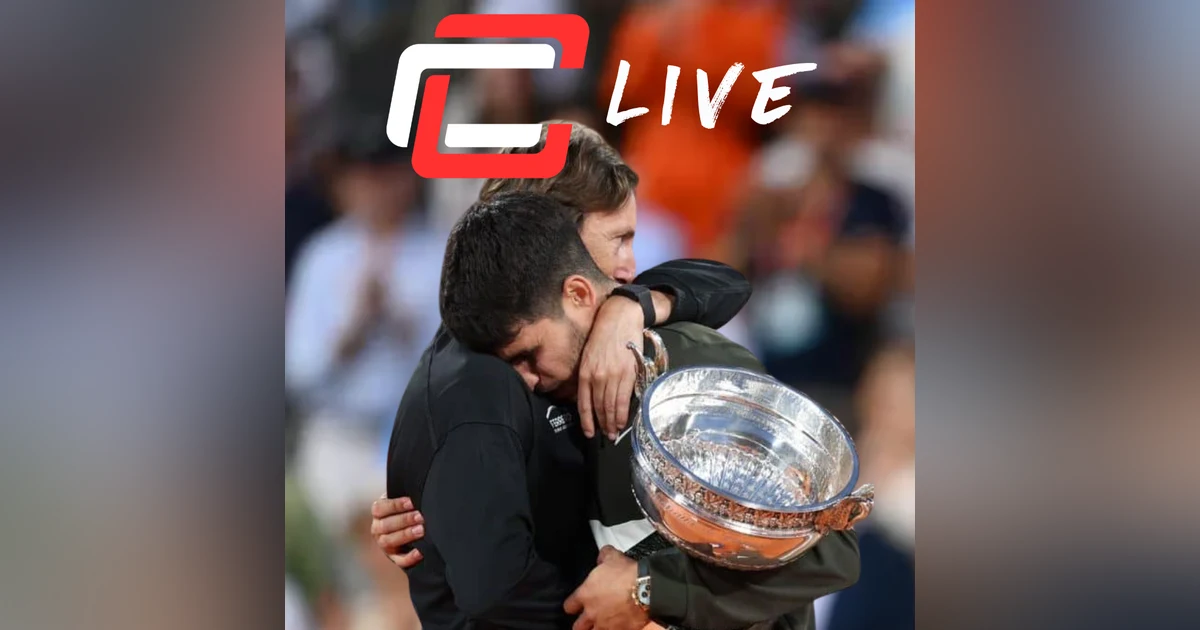
CTC LIVE: Reaction To Alcaraz & Ferrero Split

 Apple Podcasts

 Spotify

 Overcast

 Castro

 RSS Feed
One of the most successful and emotionally connected player–coach partnerships in modern tennis has come to an end.
In this episode, Dan breaks down the split between world number 1 Carlos Alcaraz and his long-term coach Juan Carlos Ferrero, analysing their statements, the timing, the power dynamics, and what it means for the 2026 season — including the ripple effect on rivals like Jannik Sinner.
Ferrero first spotted Alcaraz at age 14 near his academy in southeast Spain. Their official partnership began in 2018 and lasted 7 years.
Achievements together:
- 24 tour-level titles
- 6 Grand Slams
- Youngest world No.1 in ATP history (US Open 2022)
This episode was originally recorded live on YouTube — watch the full video version here
Follow Control the Controllables on Instagram: @ctc.podcast
CTC Tiktok: @controlthecontrollables
CTC X: @ctc__podcast
Thanks for listening!

Episode 273: CTC LIVE: Reaction To Alcaraz & Ferrero Split
DISCLAIMER: Please note we use a transcription service, so there may be some errors in the following transcript for the episode. If you can, refer to the audio for the exact quotations.
Dan Kiernan (00:00)
Hi guys and a big welcome to Control the Controllables. We are on YouTube live coming to you December the 18th. Merry Christmas everyone. Hope everyone is well wherever you are in the world. And yeah, we're kind of bringing a bit of a special episode. We weren't expecting it.
December the 17th yesterday and the news broke that Carlos Alcaraz and Juan Carlos Ferrero have split. And I guess the reason that's big news, it's obviously big news in the tennis world because of the success that they've had together.
However, I think almost bigger than that is the fact that December the 17th, you know, anyone in the tennis world will know that's just not really when teams split, you know, that tends to be at the end of the year after Turin, after Riyadh.
Okay. When people are reassessing what's happening, taking a break, and then they want their new teams in place for their pre-season as they're going into the following year. So that tells us, and it's not for me to start judging their relationship, but I do want to talk through it because I think it is interesting.
I'd love to hear your questions. You can add your questions in. We've had some in advance as well, and I will absolutely answer as honestly as I can around this, but it is, it's strange timing. And that tells me that there's probably something that has happened.
Some form of event, argument, tension, whatever it might have been for them to have made that decision, because it won't be long before Carlos Alcaraz is hopping on that plane over to the other side of the world for the first major of 2026.
And as we know from the last two years, it's the Alcaraz–Sinner show, right? That's what it has been now for a couple of years. They're winning all the Grand Slams between them in that time period.
So he wants to be prepared, you know, and I'm sure that we're going to get into it later. I've seen a couple of questions come through. How does this affect 2026? And we'll get into that. But I just want to start with a couple of things.
You know, Carlos Alcaraz started at age 14 with Juan Carlos Ferrero. You know, he was a standout junior. He kind of was a little bit lucky in some ways that geographically they were so close together, you know, coming from a little village, El Palmar in Murcia, very close to where Juan Carlos Ferrero has his tennis academy.
And that kind of officially started as a relationship back in 2018. It actually was in 2019, early 2019, where I was travelling with a couple of players for ITF Futures events, 25Ks in Mallorca.
And Juan Carlos was there and I was like, whoa, what's Juan Carlos Ferrero doing here? I think he'd recently split with Alexander Zverev and he was there with this young Spanish kid who I'd seen play a little bit and you'd heard the name.
And I had a little chat with Juan Carlos because we're the same age. We used to play in juniors. We go back a long way. Not that we've got a strong relationship. Juan Carlos has always kept himself very much to himself.
But I said, come on then, how good's this kid? And he said, he's already top 50 in the world level. And that was when he was 15 going on 16. He then went and won those two events, the two 25K events in Mallorca, and kind of backed that up.
You know, Billy Harris for the match against him, a British player. I was scouting him, hoping that Billy might win this match, as good as Billy is. Evan Hoyt, the player I was with, wanted to play Billy Harris. I didn't want to play this young Carlos Alcaraz who was smoking forehands.
And that was it. And it was very much more than just a coach–player relationship, right? We talk about these transformational relationships that often the best partnerships have. And he won 24 tour titles. He won six Grand Slams under Juan Carlos. He became the youngest world number one. He finished 2025 as world number one, won another two Grand Slams.
You know, we go back to Miami when Juan Carlos Ferrero's dad passed away. He flew out for the final. We all saw those pictures as he arrived at the hotel. They had this incredible bond and obviously he played a massive, massive role in Carlos Alcaraz's career.
So why, why, why has it happened? That's the question I think everybody, everybody in the tennis world is asking. I was actually, you know, busy, busy week at the tennis academy as we're going into the Christmas period. And then we were at a friend's house for some carols last night and my messages were coming through asking, you know, what's going on?
And I guess I don't know is the answer, you know, none of this is inside info. This is just, I guess, based on a bit of a feeling, putting two and two together. I might be making seven, but you know, I see a few things here.
And I see one: they've worked together for seven or eight years. You know, it's a long time. We see this a lot in the doubles world, that partnerships often don't last much longer than two years. It doesn't mean that people don't like each other anymore.
It often just means that, just in this kind of bubble that we live in in tennis, intense and spending all of that time together, you do build niggles. There's natural niggles that build.
I think, you know, seven or eight years in that relationship where you're with each other pretty much every day, every week. You're seeing each other more than you would see your wife, your husband, your kids, you know, your parents, your siblings.
And you're also in a high-pressure situation. You know, your nervous system is constantly switched on. You know, there's not a lot of downtime for a Carlos Alcaraz. I can only imagine, you know, all the media he has to do, his commercial opportunities and distractions, whichever way you want to look at that. So that's the first thing.
I think the second thing for me is we've seen a bit of tension for a while now. You know, if we go back to US Open 2024, there was clear tension in the team, you know, and I do think at that time you could start to see that, you know, they weren't the same person.
We have this kind of image of what a Spanish tennis player is, you know: Rafael Nadal, David Ferrer, Juan Carlos Ferrero, Albert Costa. You know, all of these players, years and years and years, it's been this kind of tough grind, a fighter.
You know, tennis academies in general in Spain have been very basic. Juan Carlos Ferrero's academy was built on basic, basic food. He lives on the academy. It's all very tennis, you know, tennis, tennis, tennis.
And there we have this youngster, Carlos Alcaraz. Not that it comes easy to him, but it's almost like he plays with a joy, plays with a smile on his face. He enjoys life. You know, he's smiling, talking to everybody at the tournaments. I would imagine he's got a bit of female interest in his world as well.
You know, he likes to party, likes to let his hair down. We've seen that on the Netflix show. And who are we to say that he shouldn't? You know, but that kind of goes against Juan Carlos Ferrero and how he learned tennis and what he understood. I think tension started to form a little bit there.
The other one that's not been talked about as much, but as an academy owner I can tell you that this is something that could potentially have caused some tension: Carlos Alcaraz basically made the Juan Carlos Ferrero Academy in so many ways. You know, that's where he trained, you know, the commercial value for Juan Carlos and the academy.
And that's where everybody wants to go and train. And then they set up the Alcaraz Academy, not too far away. You know, Carlos started to train there. You know, people then, I'm sure there's a bit of a rivalry naturally in that world, same industry, same space.
You know, he's kind of got his own, he's making his own way. His family are involved. His brother's heavily involved in his tennis. Has that caused tension? I don't know. I don't know that for a fact in any shape or form, but I would imagine it might.
You know, have there been some coaches that have been taken from Ferrero's to Alcaraz's academy? I don't know, maybe that's something, maybe there's some players that that's happened with. That is some possibility that has built this tension.
And I think then for me, what I've seen is that Carlos Alcaraz is no longer little Carlos Alcaraz. He is a superstar, aged 22, six-time Grand Slam winner, his own person. As you're growing into this space, he's looked after by his tennis dad, right? Almost his second dad, Juan Carlos Ferrero.
We've seen it. He didn't want to work with Zverev. That stopped very quickly because it's Juan Carlos's way or the highway. He's got his very specific ways. He doesn't really want to deal with that modern-day tennis player. He didn't like how Zverev was, the social media, you know, the playboy lifestyle. That's not Juan Carlos. And Alcaraz is wanting to be his authentic self.
And, you know, that's my image of these conversations: Juan Carlos has his thoughts on what he should be doing to prepare for 2026. Maybe Carlos has got different opinions on that. You know, maybe he has been slightly distracted, or the perception is that he's distracted. You know, Juan Carlos maybe thinks that his mind's not in the right place, because we have seen that before.
These little tensions and niggles have built towards that. We've obviously picked up a few things from what they've said, you know, as they made their announcements. Juan Carlos: "I wish I could have continued."
You know, does that mean he wished he could have continued, but Carlos made the decision? Or does that mean, actually, this has gone beyond my principles and values, now I can't continue under that position?
We don't know that yet, but I would have thought after seven, eight years, a nice way that this would have ended, if it ended the right way, is maybe a joint statement. You know, it happens at a natural end to the year, which is why it tells me it's something a little bit more than that.
And I guess, you know, time will tell. I don't know what that means now on the ATP Tour as we go into 2026. Is it advantage Sinner? You know, those questions I'm sure will be coming through.
I guess we will soon find out. But it was lovely to obviously hear them thank each other. But I think there's a little bit more to this story than maybe meets the eye, because of the timing, because of the statements, because that wasn't done together, which it maybe feels that this relationship deserves.
But my guess is there's just a bit of an outgrowing of each other. Carlos Alcaraz has got a lot of people around. You know, somebody said to me on text last night, he's still got six coaches. I don't know if it's that many, but he's got his brother in his corner. He's got Samuel in his corner. He's got his agents. He's got his entourage around him.
And, you know, maybe that was just starting to separate and split, and Carlos Alcaraz wants to be his own man, you know, is my guess on how this has gone. It is slightly worrying as a big fan of Carlos Alcaraz that this has happened on December the 17th, and what that means going into 2026.
Let's see. So that's where we're at. A little bit of speculation, I guess. I guess the one last thing I'd say before I jump into a couple of questions is just, for me, motivation is a big word.
You know, it seems very obvious to us that you'd be highly motivated going into a new season, going into playing a Grand Slam. But when you've had the success, when you don't have any financial worries, when you are in the position that Carlos Alcaraz is in, he has to be motivated, right?
I think we saw that in 2025. People were saying, including myself, you know, I think Jannik Sinner will be the world number one this year because he's the consistent one. Well, didn't Carlos Alcaraz show us: 70 and eight in 2025, you know, won, I believe, eight titles, the two Grand Slam titles, finished the year as world number one.
There was almost a bit of motivation. And I think we actually see that, we do see that with top stars. We've seen it with Michael Jordan, you know, there's a bit of that kind of "screw you, I'm going to show you", you know.
And where does Carlos Alcaraz find that for 2026? Because I think he maybe isn't quite the same character as Jannik Sinner, you know, as Novak Djokovic. So one of the potential issues he has is boredom in this sport, and how he maintains that motivation all the way through.
I think in reality the gap's so big between him and the other players that that's not going to be a problem, other than Jannik Sinner potentially. With Jannik Sinner the gap is small, and those guys are obviously fighting for world number one. They're fighting for the major titles.
So let's see. But a couple of questions coming in. We've got a couple coming here online. I can't quite work out your name, but Ozan, I think. So thank you for getting in touch. "Will Juan Carlos Ferrero switch to another high-profile singles player in 2026? I could see him working with another Spanish talent like Davidovich or Jódar."
I don't think so, is my personal thought. Maybe, maybe. I'm not sure that Juan Carlos is necessarily going to jump into something. I don't think he needs to coach anybody. I think, again, I've referenced it already, but Alexander Zverev, he had that. I think he's got a certain way he likes to work.
And I think there are not so many players in the world that would have that connection with Juan Carlos Ferrero. I think he's quite a tough character, clearly very, very focused and driven.
Davidovich Fokina is obviously a very, very different type of character again. You know, if we think that Carlos Alcaraz is that way, you know, Davidovich Fokina has obviously had a lot over the years, controlling the ability to tolerate his emotions. You know, quite a fiery character in lots of ways.
I'm sure he could have a massive positive effect on Davidovich Fokina, but my guess would be not. You know, the top end of the game, that will be the fascinating one.
You know, if we start to see one of those guys coming through, you know, Ben Shelton, it's a different game style, right? It's a very different game style to what Juan Carlos is maybe used to coaching. But somebody like that, to get that mentality.
We saw it with Toni Nadal as well, right? Toni Nadal, you know, hasn't really had the success outside of Rafa. There was just such a connection there and how they worked. Obviously, Toni Nadal didn't have the playing career of Juan Carlos. But I think that's going to be interesting. My guess is no, but let's see.
The other one that has come through is: what about Carlos? Who's he going to be working with next year? I'm not convinced he'll be adding anybody, maybe. I think he's already got such a big team that I think it's just probably going to continue.
You know, thinking about it, there were some tournaments that Juan Carlos wasn't going to. I do think his brother's playing a little bit of a bigger role now. You know, and he's still got a strong team around him.
So I'd actually be a little bit surprised if Alcaraz even adds anybody else to the team right now. You know, maybe through time that might come, but let's see.
In terms of a couple of other questions, somebody said: "Why is it shocking that this is happening? Because Carlos is still number one. It will happen one day." Yeah, and absolutely, you know, I don't think it is shocking. I think seven or eight years is a long time in any relationship of this type.
And it's not easy, right? You know, we look at other sports as well: league football managers, NBA basketball coaches, NFL coaches. Look at the Lionesses manager, who was with them for many years, but life moves on at some point.
I reiterate what I said earlier. For me, I would have had almost no surprise if it ended at the end of the year. I think more of my surprise is the timing of it. I don't actually think it's the act of them moving on from each other. I could see that a little bit, you know, just reading between the lines, like I mentioned, with the tension and with different things.
Obviously they've had an incredible 2025; more than likely they've agreed to work 2026 together. And then something has happened in the pre-season that has led to this decision now being made. That's what logic would tell me, and that's more of the shock for me.
We had this from Oli Correz. He said: "With the supposed reason being Carlos wanting to break away from his tennis dad, how will it affect his season? Will it cause Sinner dominance in 2026?" We've had the same question coming from three or four of you.
Time will tell. Who am I to say that Carlos is going to be deeply affected by this? You know, the guy's an absolute phenomenon. You know, he really is. My gut feeling, and I've said this a few times, is if we're talking about over a five-year period, a six-year period, that Jannik Sinner will win more Grand Slam major titles than Carlos Alcaraz.
I said that at the start of the year, and the reason for that is I feel he's a bit more disciplined in everything he's doing in his world, and that will lead to the consistency.
But I said that at the start of 2025 and Carlos Alcaraz shoved that right in my face, because, like I said before, he went 70 and eight on the year and finished the year world number one. But that's a year. You know, can you do it for two years, for three years, for four years?
And also I think it's unlikely, you know, if we just know the history of tennis, that it's just going to be those two players, right? Somebody is going to come up. There's going to be injuries. There's going to be, dare I say, another drug ban of some sort at some point for somebody.
You know, as we know in life, we've got to live a very humble life because you never know what's around the corner. So I think it's going to be very interesting. We're all talking about Alcaraz and Sinner; maybe someone will surprise us and jump in there in the next 12 months. I certainly think in the next 24 to 36 months somebody will. So yeah, let's see.
"What are the next steps for both Juan Carlos and Carlos?" Yeah, we've already talked about that. So Nate, thank you for your question, and hopefully that was answered.
Again from Ozan, thank you: "How awkward would it be at the Ferrero Academy if Carlos still wants to train there and have his base there, albeit not being with JCF?" I think this all depends, right? This all depends on what has actually happened. Has this been a fallout?
If this has been a fallout, Carlos Alcaraz won't be training at the Juan Carlos Ferrero Academy. You know, he doesn't need to do that, right? I'm sure he's doing that so that he's there. Juan Carlos lives there. He's got his house there. And he's got his own academy, the Alcaraz Academy, now. You know, he can train anywhere in the world, right?
So if there's been a fallout, I think that would obviously be the end of that.
If there hasn't been a fallout and it's just that they've had a couple of honest conversations and gone, you know what, now's the time, big love, big hug, life moves on, which is, there's no problem having professional breakups like that. You know, that's absolutely the way it should be. Then I don't see any reason why not.
So let's see. I just have a little inkling, and maybe it's from personal experience, but I have a little inkling the academy thing is something, you know, and it's more leaning into that, like the dynamic of the relationship has changed.
You know, when you're coaching someone from a young age, you tend to be the person who is in control, who has the power, which is why it's a dangerous position to be in as the coach as well. You know, when you're with younger players, they're looking up to you.
You know, when Juan Carlos is a Grand Slam winner, Carlos is looking up to him: wow, wow, wow, whatever, oh my God. And then he's made his own way. And now there's a flip, right? Because he's now the six-time major winner. He's got the millions in his bank.
He's the one that everyone wants commercially. He's the one all of social media wants. He's the one everyone wants to talk to. He's a very humble guy, Carlos Alcaraz, but it's going to get in your head a little bit. So there's a dynamic shift.
To make relationships evolve over a long period of time, you have to find a way of shifting with the natural dynamic shifts. Maybe that's just what this is: they haven't been able to grow with the natural evolution of what's happening in their worlds, because of who they are and what they are doing and what that all stands for. So let's see.
If there's another question or two coming in, please do send them in. Otherwise, I will just get to a couple more that have come in online. "Do great player–coach partnerships end better at the peak, or do they usually break under pressure?" Good question.
You always want to go out at the top, right? I think it's a good way, and you have to have good awareness to be able to recognise that maybe all good things are coming to an end.
And, you know, if you're able to catch that moment, which is hard to do because we're all a bit greedy in this world and we all think that we can be the one that's able to do the job. You know, but yeah, there's definitely an art to that, to be able to recognise: do you know what, this is the sweet spot.
We've had this amazing time, this amazing period together, but actually, you know, maybe it is time to move on from that. So I think that's absolutely possible.
I think, unfortunately, in lots of relationships, player–coach, player–parent relationships, it can end based on assumption-based communication. So what I mean by that is that people aren't having the honest conversations, or people are thinking that the grass is greener on the other side.
You know, but if you've got that strong relationship and you're having those conversations, there are going to be natural ebbs and flows in any relationship, and having open, honest communication is massively important.
But obviously under pressure and under absolute stress, and I can't stress this enough, at the highest end of the game, as much as, yes, they're sorted with the money in the bank, there is so much stress and pressure around you on a daily basis.
From the media, from commercial output, from everywhere, from social media, from, just like I said, playing in front of thousands of people and then millions of people on TV. The nervous system is absolutely locked in and that's tiring, that's hard.
And that can lead, we all have our arguments with our friends, our partners, whoever it might be, when we're tired, and having that awareness of that matters.
And that's where I think, sometimes under pressure, it doesn't feel like that's this, for me, because preseason tends to be the time where the pressure dilutes a little bit and it's like reset, spend time with the family, which is why I keep saying it. I believe that something has happened.
I hope, because they're two absolute legends of our game, I hope that the thing that did happen was just honest conversations and they decided it's best to move on. Maybe, from their statements, I'm not so sure.
We have one coming in here from Jermaine. Thank you. "Would you be willing to coach Alcaraz? And if so, what would you focus on in his game in order for him to improve and be better than Sinner in 2026?" Wow, what a question.
I mean, come on, he's not going to be asking me, I tell you that right now. But, you know, I'll play along with that game, with the understanding that I don't for one minute believe that that's going to be asked of me. Yeah, I mean, what a dream. I think what a dream to be working with someone like a Carlos Alcaraz, right?
But also what a burden in some ways, you know, because how do you win that game? You know, in 2025 he's gone 70 and eight. He's won four of the last eight majors. He's 22 years old, won six Grand Slams. He's got 24 titles with Juan Carlos. There are going to be these natural comparisons, whoever the next person is that comes in.
You know, so first and foremost, yes, because you can't say no if you love this sport like I do and you had an opportunity to be around arguably one of the greatest ever, certainly male tennis players in our sport. You know, what a privilege. What a delightful young man he is as well. You know, he seems like someone that you want to be around.
In terms of his game, I think certainly the serve is still a continued area. I believe that his serve is getting better and has got better.
As we heard when we spoke to Tom Corrie from TennisViz a few weeks ago, he does have the 67th best serve statistically, you know, in terms of the metrics that they look at on the tour. So there's clearly big room for improvement there.
You know, in terms of his ability to hit his spots consistently, I think he's massively developed the wide serve on the deuce side this year. We saw that on the grass courts. He used that incredibly well, his ability to open the court. I think that's a massive area that he has developed.
We have seen him also coming forward well. Obviously he is a good volleyer, but he needs to be, not needs to be, but can be a better volleyer, you know, in terms of maybe the moments that he picks, but also just being a little bit more clinical.
I don't have the data on that. I'd obviously like for that to be backed up by data. But my feeling is he could be a little bit more clinical at the net.
With a player like that, I don't think you're going in and looking to make big technical changes, right? You know, it's more about that. I mentioned it earlier: how can you play a role in maintaining that motivation? You know, how does that motivation stay high?
You know, with some people you can have that conversation and you can put things in place. With the superstars, you've probably got to be a little bit clever.
You know, I don't know if they did it with him last year, but if somebody was going, my God, keep on dropping the news articles of people saying, "Yeah, Jannik's going to be world number one this year because he's more consistent than you, Carlos", you know, you can maybe do that indirectly.
So maybe this year the motivation is, obviously, if there has been a bit of a niggle with him and Juan Carlos, you know, people are saying that you're going to have a great year, you know, now that you're not with Juan Carlos. You know, maybe that's it: finding those little bite points that are keeping the players absolutely motivated.
And then lastly, what I would say is I'd make sure that he takes me with him to Ibiza twice a year. Two times a year. He looks like he has a lot of fun and I'd be up for that.
And that's where I'd connect with him. That's where we'd get close, out on the boat, diving into the Mediterranean, sipping on a cold beer. I think that seems like a good way to build that relationship with Carlos Alcaraz as well.
Guys, thank you for jumping on. Thank you for all the questions. I did say on the last podcast this was going to be the last one before Christmas. We felt it was right to just jump on with this one. We might have a little short actually coming from Lloyd Glasspool. He was our 80th guest a while ago.
Lloyd Glasspool is someone I coached from a very, very young age. Obviously he's finished 2025 as the world number one doubles player, Wimbledon champion with Julian Cash. An incredible story. And we wanted to share a couple of little soundbites from that one. So look out, we might have one of our shorts coming out.
Me and Vicki are going to try and get to you with a year-end podcast as well, pulling out some of our favourites over the last 12 months. But there'll also be a little period, hopefully, where the laptop gets shut and we don't see a tennis court just for a few days, before we're absolutely chomping at the bit to get back for a brilliant 2026.
So hope everyone is well, wherever you are in the world. Have a very Merry Christmas if you celebrate it.
Obviously it's also a time of year where people have lost loved ones and it becomes a difficult period as well. So thinking of everyone, wherever you are. Please do get in touch, as always, with the podcast. Until next time, I'm Dan Kiernan and we are Control the Controllables.


