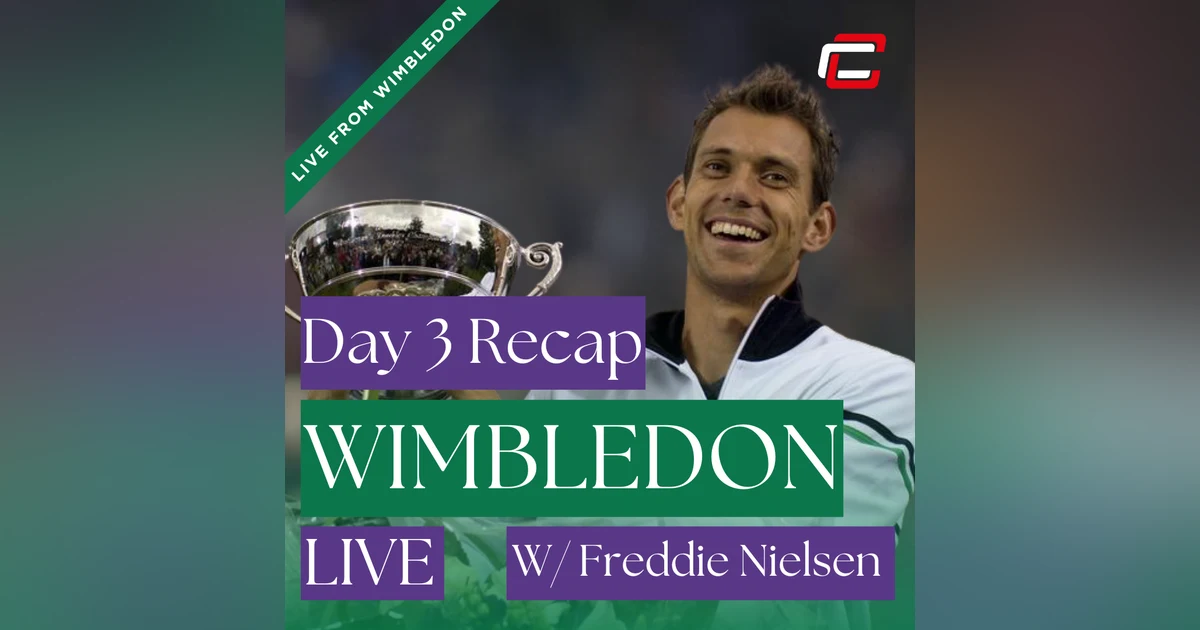
Wimbledon Day 3 Recap w/ 2012 Wimbledon Champion, Freddie Nielsen

 Apple Podcasts
 Spotify
 Overcast
 Castro
 RSS Feed
 Day 3 of our Wimbledon 2026 daily live series, recorded inside the grounds.
Brought to you by Novellus.
Live every night at 9pm UK across the Wimbledon fortnight, with Wimbledon champions, tennis icons and special guests joining Dan to break down the day's biggest stories from inside the grounds at SW19.
A quick note: today's episode runs a little longer than usual as Dan and Freddie dive into the significant news emerging around proposed ATP doubles changes and what they could mean for the future of the sport.
In this episode:
- Major Moments (brought to you by SotoTennis Academy): Krejcikova ends Mirra Andreeva's Wimbledon hopes, Dan's Bartunkova prediction comes good, and Jannik Sinner records his 95th Grand Slam win
- Bublik and Kyrgios lose to Arevalo and Pavic, sparking a passionate discussion with Freddie Nielsen on the future of doubles and the proposed ATP changes
- Dan Evans' retirement announcement, his unforgettable Washington title run, and why his career should be celebrated
- Freddie relives his 2012 Wimbledon title run with Jonathan Marray, including the famous "If Carlsberg did moments to live for" exchange before serving for the title
- The Wimbledon Quickfire with Freddie
- TennisAthlete Player of the Day: Jenson Brooksby, completing one of tennis's most remarkable comeback stories
- Dear Dan: what separates the world's best doubles players, coaching Grand Slam finals, and Dan's favourite court at Wimbledon
- Tomorrow on the show: Jonny O'Mara joins Dan to preview Day 4 at SW19
About Control the Controllables Wimbledon Live
Dan Kiernan and a different special guest every night, bringing you analysis from inside the grounds at Wimbledon. Wimbledon champions, tennis icons, players, coaches and analysts join across the fortnight. Live every evening at 9pm UK on the CTC YouTube channel.
Send your Dear Dan questions via Instagram @ctc.podcast or email info@sototennis.com.
Brought to you by Novellus.
Major Moments segment brought to you by SotoTennis Academy. Visit sototennis.com.
Player of the Day brought to you by TennisAthlete, age-appropriate, research-backed strength and conditioning programmes from proven S&C coaches. The platform Dan recommends for physical development. Visit: sototennis.com/tennisathlete.

Episode 291: Wimbledon Day 3 Recap w/ 2012 Wimbledon Champion, Freddie Nielsen
DISCLAIMER: Please note we use a transcription service, so there may be some errors in the following transcript for the episode. If you can, refer to the audio for the exact quotations.
Dan Kiernan (00:01)
Hello and a big welcome to episode three of our Wimbledon Lives brought to you by the Novellus. This is the series where we're gonna bring you analysis from inside the grounds at SW19. And as the last couple of days, our segments involve the SotoTennis major moments of the day, the tennis athlete player of the day, our special Wimbledon stories and memories…
with our special guest of the evening, and then a quick fire round, and then as ever we will finish with our Dear Dan. Any questions that you guys have, please send them in and I'll be answering as many questions as I can at the end each day. Your chance to try and pick my brains, ask what you have always wanted to ask us here at Control the Controllables. And as a starting point…
Our guest this evening is also a Wimbledon champion. 2012 men's doubles Wimbledon champion, Freddie Nielsen. So what if you follow the podcast and are part of many of our podcast shows that we bring to you pre and post the Grand Slam events, then you will find that Freddie Nielsen, a popular guest always is going to join us. And I think it's especially…
especially evening for him to join. You know, some of you might have heard the news on social media that is coming out about doubles on the ATP side. I we're going to hear more in the next couple of days, but I know it has been made public. So I think having Freddie on to be able to discuss that. And obviously today the doubles also started at Wimbledon. know, it's always the men's doubles started today. So many matches played and then tomorrow we have the rest of the first round men's matches. Then we have the women's doubles…
also starting tomorrow. But to get us started, our our soto tennis moments of the day, there's lots as always. The stories keep coming thick and fast here at Wimbledon and you know Yannick Sinner, anybody that watched that, had his 95th career Grand Slam wintered against Nuno Borges. Not easy. 767664. That's the most ever Grand Slam winning…
matches by an Italian by the way. I would expect that that's an Italian man. but that is, that is what's my, what my notes say. so I'm going to say Italian man. And if it is Italian man or women, then even, even more amazing. I learned at the end, the number 16 seed has gone out losing to Marton Fucsovics in four sets. Tommy Paul was playing on, on court three was watching that on the balcony earlier today. He went through in straight sets. Davidovich Fokina finally won an ATP event last week in Majorca.
And then he is going strong into the third round. A player that we've said to watch actually, number 31 seed, Ignacio Buse, is out, lost in straights at 6-2, 6-2, 6-3 to Jenson Brooksby. Now, Buse is a real one to watch, however, maybe the grass courts he still needs. I think these players do need a bit of time on the grass courts. It's hard to come out firing very, very early on in their careers.
And one that is a little bit of a pat on my back. You know, if you listen to our, our, our previews, we like to big ourselves up with our picks, even though we tend to have rubbish picks, but I did tell you all to watch out for Bartunkova, Czech Republic, and she beat the number 32 seed, Katerina Sinniakova, 6-2, 6-4 today. She's good. Watch out for her.
I talked about it earlier in the week. I talked about her on the preview. She came close to beating Aryna Sabalenka, setting a break up last week. She's seriously good. She now goes on to play Krejcikova, who is absolutely one of our moments of the day because she's taken out the current Roland Garros champion in Mirra Andreeva. Now, if you listen to the podcast a lot, will know as much as I think Mirra Andreeva is an incredible player.
I absolutely have not backed her to do well at Wimbledon. I just don't believe that right now she's ready to do it on grass courts. I see two big weaknesses, which she fair play to her, at Roland Garros. She managed to handle them very well. One is the emotional side. We did see her at the end of the match throw her racket into her chair. And absolutely, you know, that's maybe to be expected when you lose a match. She lost the match in...
in three sets against Krejcikova, four, six, seven, five, six, four. But the big one for me is just the forehand. The forehand of Krejcikova, the forehand of Andreeva, I just don't think is a great forehand on faster courts, lower bouncing courts. I think on a clay court, she can manage it quite well, but I don't think she can manage it so well on a grass court. And obviously Krejcikova champion here.
Only only a couple of years ago knows her way around a grass court knows a way around the major championships and Krejcikova moves on and now players Bartunkova in the next round. And our next moment of the day that I want to talk about is is I saw this draw come out and obviously we're to talk a little bit about doubles when Freddie comes on and But it wasn't so long ago that Alexander Bublik..
I said doubles is not tennis. It's half court tennis. If you can't play singles, you play doubles. If you can't play doubles, you play padel. Very simple. And he's made that comment alongside many other comments. And why that really gets my go to really get to my nerves is these comments are all feeding into people, the decision makers at the ATP. Why or why or why we have to be in a position where we're degrading other tennis players.
They're all professional tennis players out there on the tour. Some of them happen to be better when it's one-on-one and they are the ones, it's a meritocracy. Those are the ones that have the highest ranking in that form of the game. The ones that have the highest ranking in the form of the game where there's two players on court are also professional tennis players. Why we need to degrade that, why we shouldn't be celebrating each other, I do not know. And Alexander Bublik, unfortunately, has been one of the biggest advocates of that.
Alongside his partner, Nick Kyrgios who's also been quite derogatory towards doubles specialists. Again, just their professional tennis players, that's what they are. They're putting the work in, they have done since they were five years old. You know, no one's more special than anybody else. know, maybe Carlos Alcaraz and Jannik Sinner can tell us what to do, you know, on Aryna Sabalneka. But if you're 30, 40 in the world, I can assure you, you're not selling any more tickets than...
somebody who's playing doubles, you're not anymore for TV rights and all of these different things. You're just part of the traveling circus that is providing entertainment and content and playing your role. Let's start celebrating each other. Let's start talking about everyone as professional tennis players and acting in a professional way. Now, Bublik and Kyrgios did play Arevalo and Pavic, one of the best doubles teams in the world, one of the most professional…
tennis players out there in Arevalo and Pavic. They've been doing it for years. And I think that was an interesting one. was big, big crowds on the outside courts. And as I would fully expect Arevalo and Pavic won that match 6-3, 6-4. And I'll tell you why they won 6-3, 6-4, because they're better. You know, in a doubles match, they are better than Bublik and Kyrgios, full stop. That doesn't mean a one-off match that Bublik and Kyrgios can't win, just like...
You know, if you put someone who isn't as good at high ranked in singles, can have those wins. But they are the better team. They showed it today. Kyrgios, as usual, swore, shouted at the umpire, you can find me. I honestly don't care, he said. And for me, just that, that is a real moment of the day to talk about the doubles changes that I've mentioned now.
I do know a little bit more about this. It's not my role quite to bring this out yet because there's more going to be coming in the next couple of days, you know, from the players, but there is something that's been made public and it was being made public by Lorenzo Eccoli, an exclusive on Spacio Tennis on X. Doubles at Risky said yesterday, more or less 50 doubles players met with the ATP and received updates about the future of their discipline. From 2028.
Prize money could be distributed for an 80-20 to a 90-20 model. Draws could be reduced to 16 teams at Masters 1000 events and eight teams at other tournaments. The doubles players, especially those who are still far from retirement, are expected to strongly oppose these proposals. The ranking points would also need to be redesigned, but the biggest concern is breaking into the doubles tour could become almost impossible for pure doubles specialists. Now watch this space on this, because what's happening, I don't like it at all.
You know, I really don't like, and I don't like in our sport that we have these egos, we have this weak leadership that is allowing these things to start being passed just by egotistical, normally men that are making these comments that have maybe got jealousy of certain money that's been made rather than fighting the real fight, which is going up against the tournaments and actually trying to get a bigger revenue share. Why are we trying to take money off people? Why are we trying to lose jobs in our sport? We should be trying to...
create jobs. watch this space on that and this is good timing because we have our guest Freddie Nielsen joining us. Freddie a big welcome, how you doing?
Freddie Nielsen (10:11)
Thank you. I'm doing great. Thanks for having me.
Dan Kiernan (10:13)
You just came in during my rant, which we're going to jump into a couple more things. I want one more of our moments of the day. And actually this is where I'll bring you in first. I know we did talk about it a little bit on the, on the preview show as well, but Dan Evans was in tears today at the court at Wimbledon, retired 36 years old, career high ranking of 21 achieved back in August of 23, two ATP…
titles in Melbourne, the summer set back in 2021. And then the ATP 500 in Washington. A bit of a funny story actually that I'm sure Dan won't mind me sharing, but the Washington one, he actually was speaking to, I don't know if you heard of the Brad Gilbert story.
Freddie Nielsen (10:56)
No.
Dan Kiernan (10:57)
So, so he's in Washington and he wins his first round and Brad Gilbert was there. He was helping some player at that time. I if it was maybe Jess Pegula or Coco Gauff, Coco Gauff.
And he was there and he said, Brad, look, you're having a conversation. What did some of these players do at these events? And he said, look, and I might get the drink wrong, but I think he said it was a tequila shot or a margarita. What you need to do, Dan, is you need to have a couple of margaritas. And that'll just turn the tone. So Dan ended up having a couple of margaritas after his first round. And then the next day when he's second round, then he saw Brad in the bar back at the hotel.
Freddie Nielsen (11:39)
You
Dan Kiernan (11:40)
Brad gave him the little nod and said, of the same tonight, Dan. And Dan made his way all the way through the ATP 500 event drink and two margaritas every night. Some would argue maybe that was less than he used to drink at some tournaments, but the two margaritas got him through. What he said after the match, you think of your family and all the sacrifices. I was one of the lucky few who got to play here. Everything was worth it in the end. Anyone thinking about putting the work in, it's absolutely worth it. And I think...
Those are nice little sentiments that Dan's made at the end of a great career for the young man. He's only 36 years old, but I think it's nice for him to leave those words with us as well.
Freddie Nielsen (12:21)
Absolutely. People tend to focus a lot on what it takes away. I've always said, when people have asked me about it, that it gives you so much. And every choice comes with you losing something else. And I couldn't agree more with his statement. mean, it's totally worth it.
And people ask me, know, what if your kids want to play tennis? And I'm like, yeah, great on him. How can I say they shouldn't do something that has given me so much? And I'm happy to hear that it's given him much. He also does seem like a passionate guy who wouldn't be doing it if he wasn't really into it. So that's nice to hear.
Dan Kiernan (13:12)
And also Freddie, we've been through the moments of the day, our subtle tennis moments of the day, but one, we did talk about it on the preview. Now, as I mentioned the preview, I think your statement was the hot take that you left us with was it was gonna be the year of the Brits.
Freddie Nielsen (13:30)
I think it was, I mean, I must have been hot in my head from qualities because from the actual hot weather because that seemed to backfire, right? That was a poor take. Wow.
Dan Kiernan (13:41)
0 for 10 on day one.
Freddie Nielsen (13:44)
I mean, maybe the pressure of Wimbledon, I underestimated it for how tough it can be on the Brits. In history, has seemed to make it difficult for many Brits, but I genuinely believe that it seemed like there was something else going on. Egg on my face, though.
Dan Kiernan (14:08)
And one of the ones that, I I had egg on my face during Roland Garros. definitely didn't fully backhand Draver to win the title. I know we mentioned it, but I actually said, I think the forehand is gonna let it down. It's just a shot for me that when I think about winning the biggest of events, I always think, I always have this kind of saying in my head. It's actually,
I link it to England, the England football team who just scraped through tonight due to the genius of Harry Kane. But you can't protect yourself to a big title. Now you might be able to do that, maybe. Like under 14s, we all probably did it sometimes, right? We kind of protected ourselves to a title where we were the favorite. Maybe Rafael Nadal at Roland Garros could protect himself a bit to a title because he was so much better than everyone on clay.
But in general, you have to go and grab it, right? You have to go win it, play to win mentality, go and get it. And I've all, when I've watched Mira play, I've always just felt that that forehand, a bit like Alexander Zverev on the forehand as well, it gets quite protective. It doesn't, it doesn't go and grab titles. But I certainly felt for Andreeva going into Wimbledon and we just talked about it before you came on, the grass court are not suited for that, you know? And I think, she was seeing the 2024 champion.
Babora Krejcikova on the other side of the net who just hits the ball like a bullet through the court. Wasn't the perfect draw for her but she's gone out to day six four in the third set.
Freddie Nielsen (15:49)
And that's where I think even though it slowed down so much and all the facts and the stats of grass say that the rallies are the same length as everywhere else, it is still one of the surfaces where you can expose things like this, right? The low bounds. You can make the ball skid in fast to a shot like that. And just like with Andre, when you mentioned Zverev as well, he was also, he had a tough time…
In his first round against Blockx. So it is kind of more possible to exploit a technical, I wouldn't say flaw, maybe kind of shortcoming on the grass still. think it's quite nice actually that there's still a little bit, I don't think it's enough, but you still see the element of the surface play in that way.
Dan Kiernan (16:50)
And moving on to our next topics, Freddie, we shared a couple of text messages before. I didn't know if you'd heard about it. Obviously we have talked about Arevalo and Pavic beating Bublik and Kyrigios, which I think was quite an apt match today. You know, that was maybe, as you came on, I was having a bit of a rant on just basic, can we not just celebrate people being professional tennis players? Can we not just just want to celebrate each other and give more spaces for people?
You know, why are we doing this? Because the news and I don't want to go massively into it because I'm only talking really about what's, what I shared with you that's been made public, but it seems like this serious movement now happening from, the ATP. So, so people understand this as well. have, you have ATP is obviously separate from WTA and separate from Grand Slams and the councils that are, that that are run that are a big part of the decision-making process.
With the WTA actually on those councils, you actually have quite a bit of player power and they've set that up in the way. I don't know if you knew this already, but they've set it up in the way with the WTA that no decisions are made without the player representatives on the board having input. it's a big job. If you're on the council at the WTA, you are actually dealing with a lot of things. Now on the ATP side, really the players' representatives, which I believe are Vavassori and...
Arevalo on the doubles players. They don't actually get spoken to about what decisions they're looking to make. They get spoken about what decisions have been made. So it's very, very different, you know, in terms of the position. And I guess what we're starting to hear is that there's maybe some news coming out that they are starting to make some changes.
We're looking at the prize money being changed in 2028, looking at the draws being reduced, looking at the pathway into the ATPs just being based on a singles ranking, no longer a doubles ranking, which technically, and the way I see this is some countries have this rule where in one year you have to be 18 to smoke cigarettes, the next year you have to be 19, the next year you have to be 20, the next year you have to be 21, and over 60, 70 year period, that's gonna make…
make cigarettes extinct because nobody's going to be old enough to be able to buy them. And it feels a little bit like the system they're looking at is maybe going along those lines of the only way to get in is through your singles ranking. So all of a sudden, no double specialists will be able to come through.
Freddie Nielsen (19:35)
Yeah, I I've been pretty resigned to the fact that it has seemed for a long time that the governing bodies of tennis, don't really want doubles. The tournament directors don't want doubles. And I've kind of mentally been accepting that it's going to happen sooner rather than later.
And I find for me personally, it's always a little bit difficult to talk about these kinds of things because I feel like I'm in the minority here because people will throw numbers and stats and supply and demand and all these things at me. And I don't really care about that too much when it comes to decision-making. for me personally, I kind of feel we got to protect the sport and then I'm absolute okay taking a hit.
Financially, which I don't believe it. mean, if you, if, you market it well and stuff, I think you can absolutely gain the same out of having doubles and, and you can sell it to whatever betting rights there are the same way that you are selling challenger matches for, betting rights and all that. But it's, it's a sport. I know it's entertainment, but it's sport as well. And I'm very, very pro the sport side.
I mean, to me, it's a little bit like if the marathon started getting unpopular, we'd just say, let's just run 10 kilometers because then it's quicker, we can show it on TV. You the marathon is the marathon and tennis is tennis and singles are singles and doubles is doubles. so to me, it's part of the whole package. And I would always try to make it like that and take the hit. But I know that I'm...
in the minority. also understand a lot of the arguments about ticket sales and people coming out to watch and whatnot, but I don't really care too much about that. think you have your product and you make the most of it and then whatever that is, then you try to make it work. And if you don't believe in the project yourself and you're not able to sell it to the rest of the world, then how is the rest of the world going to believe that the product is worth it?
I think it's a real shame and it feeds more and more into, we see it everywhere in the world, right? Money talks, you're not in it for the sport, you make changes to be able to sell and generate more revenue, not for the betterness of the game. And I think it's everywhere and I think it's quite sad and I don't particularly like it.
Yeah, it's not surprising to me, to be honest. It's really not surprising, but I think it's inevitable the way that the majority of the world thinks and the majority of the world. I mean, we see it now in the World Cup, ridiculous hydration breaks, right? And they're kind of hiding it behind player welfare. And I'm like, okay, if it's player welfare and it's not money, just don't sell any advertisement. Don't call it the...
Dan Kiernan (22:56)
to turn the air conditioning off.
Freddie Nielsen (22:56)
The hydration break has a name, know, a sponsor name. don't want to...
Exactly. So it's to me, it's you see, even see it in the Olympics a lot. And I don't like that at all. think, yeah, keep the sport, the sport and then whatever happens, happens. And to me, it's amazing.
Dan Kiernan (23:15)
Think it's a conversation me and you could have for two hours, right? And this is a…
Freddie Nielsen (23:19)
Yeah.
Dan Kiernan (23:20)
Relatively short podcast, but it's the only point I'd just like to make on it. think a lot of, I think the fact that the sport is in a place where there's in-house fighting amongst the players is the wrong place for the energy to be going. It's the wrong place for the greed to be going or the, if it is, this is financial, which it is, right? And it's about…
It's about a certain set of players believing they're entitled to a bigger pot of the money because they don't value them. For some reason, they degrade another set of players and they've got enough people in leadership roles that are probably a bit jealous that they weren't making that money when they were playing. And they happen to be on the side of a certain set of players…
rather than I go back to this thing is why are we not all celebrating and pushing the sport forward together? because actually the biggest fight to have here is actually with the tournaments to get a bigger revenue share. That's the harder thing to do, right? you make your product, market your product so well that you are in position of strength, but also have the right conversations that you are pushing…
to get like, we know like Wimbledon's 14.9 % that Wimbledon are playing, paying of the revenue, right? You know, they wanna push that for 22. Well, that's a difficult conversation to have, but do it with Wimbledon, have it. You know, push that forward together as one. You know, the fact that there's become this kind of separation within it amongst the players that they're saying, well, actually let's scoop the money from these because they shouldn't be making that money, which is a completely ridiculous way of looking at it. But let's bring that money over to here.
And actually now we're not having the bigger fight, is with the tournament directors, it's with the other tournaments, it's with these big tournaments that are making a shed load of money, out of the product of tennis. They're not making the money out of the product of singles, they're making the money out of the product of tennis. And part of the product of tennis is you have men, you have women in the Grand Slams and the 1000s, you have men, you have women, you have people playing one on the court, people playing two on the court.
You have some superstars, have peers are playing against superstars. You have exciting matches, you have easy matches. You you know, you have like a bunch of, it all goes into what the product of tennis is. And I just would like to think that the players could stick together and create a better product, get the narratives out there, get the storytelling out there, sell the sport even more, and then have the hard hitting conversations to get…
more money coming into the sport so we can professionalise the sport. This feels like a bit of an easy option and a bit of a weak leadership option driven by greedy egos that are influencing the decision makers.
Freddie Nielsen (26:23)
And from my experience, from what I've heard and what people have told me and throughout time with the player boards, the reality of the situation is that there basically no players are thinking about the greater good of the game or the game in 20 years time. They think about how can I benefit right now and then what else happens? They don't really care about and...
I think you can kind of understand that to a certain degree, but it's also a shame. when you say that people should come together, yeah, I don't disagree at all, it's just, it's not really realistic to happen, I think, because everybody is in it for their own sake. There's no unity. This is how it should be for everybody else. So how is the sport going to grow? I think a lot of these, a lot of players.
If the sport is dead in 30 years, they don't care as long as they max out their time in—
Dan Kiernan (27:25)
Yeah.
Freddie Nielsen (27:26)
—the sport. And it's a real shame. And like you say, the infighting is, you know, you players abusing the doubles players and then there's this and that. And it just makes it, it's such a shame. know, it's.
Dan Kiernan (27:39)
But the WTA seem to be doing it pretty well for Eddie, that's my point. My point is, you look at honestly, if you look at the way the WTA are doing it, and I'm heavily involved, not at that level, but in terms of coaching some of the best WTA doubles players in the world, and I get that insight, there is real positivity and from the leadership within the WTA, they love how doubles is going. You look at the WTA…
social media channels, are definitely doing a better job. They could still do a better job, but they're doing a better job of the marketing that they're doing. They really are. So I think the WTA are showing it is possible. And me and you are privileged white males, but privileged white males running the sport on the men's side of the sport.
They don't, they're not seeing things from a different point of view. You know, we had this conversation around a couple of the wives today and they made a really good point. They said, this is what we as women feel all the time. You know, what the doubles players are feeling and the things we were saying, they were like kind of welcome to our world. You know, and that was quite sobering to hear actually. You know, and I think that's the bit that this carries for me…
because I do strongly believe that this is heavily, heavily linked to male ego. And this is heavily linked to male entitlement, ego, inability to see the world out of other people's eyes. And that makes me feel a bit sick. know, that's the bit that goes to my core. We could talk about this for hours. We'll maybe talk about it more. Obviously there is gonna be more news coming out. I'm here over the next few days.
Maybe we're not fully on the ball. Maybe the social media channel, the social media post that we read out isn't exactly correct. But there's definitely movement. There's definitely obviously something we feel passionate about. And I feel very passionate about the future of our sport. You know, and I don't like to break it down into singles, doubles. It's just, I want it to be very much, you know, let's professionalise tennis and let's give more and more people opportunities. And certainly let's not lose anybody's job.
You're here because you're the Wimbledon champion, Freddie, Wimbledon champion 2012, you know, and this 14 years on, you know.
Freddie Nielsen (30:11)
It's not to highlight my poor hot take this early in the conversation so you can sit up for the preview how bad it was.
Dan Kiernan (30:18)
No, that's not. don't want to. I'm not. This is not for me to take you down. I'm privileged to have you coming on the podcast, you know, these couple of weeks, you know, to have you guys amazing guests to share your stories. And, um, you know, so I want you to take me back to 2012. You know, I know it was an unbelievable run. know there's lots. We did actually about a four and a half hour podcast when we started the podcast with yourself and Johnny Marray.
So we kind of went into all the details. So let's kind of dart right at it. You're now finals day, you're on the center court. You find yourself in a position where you guys are serving for the match, five set match. You've got this wild card into the event. You've beaten some top teams, beaten the Bryan brothers in the semifinals. You you've gone on this amazing run, but now it's real. So tell me about that moment, how you and Johnny handled that moment and any little stories that came along that way that you reflected.
Freddie Nielsen (31:18)
Like you said, so much has gone on and it really was a roller coaster ride that whole final. I'm not going to go through the whole lead up because there was so much, but just small things. You can't warm up on center court, right? That day we had been given a chance to get in and see the court from court view so that it wasn't going to be completely new. But when we walked from the locker room to the court, I remember thinking...
Don't think I've actually walked this way. I can't remember if I was the first or if somebody was front. I'm like, I'm not entirely certain I know where I'm walking. And that's how the day started. And then we walked on and for one and a half sets, it felt like they were absolutely destroying us. It felt like they were hitting the ball 10 times faster than we were. Then all of a sudden, momentum changed. They could close out the second set. At the end of the second set, we were up.
We served first, so we got to 5-4 and it felt like they got a little bit tight. We got a lucky, lucky game to get to 6-4. It felt like momentum completely changed from then. I got injured. There was a bit of rain after the third set, so there were injury times. We had to wait for the roof to come on. We were up 5-2 in the fourth set breaker. I served at 5-4. We lost two random points. We lost that second set, but by then there was a big crowd and the atmosphere was there…
was really massive and I was, I was feeling great. wasn't too upset about it actually. And Johnny went to the bathroom and when he came back, I was kind of thinking, I hope he's not too disappointed because I'm still pretty confident and he was not bothered one bit. And he came out in the first service game of the fifth was, was just completely solid. Didn't give an inch from Johnny and we got an early break. then when we held to four one…
I think it was 40-30 and Tekao hit a return at me and I can't remember if I hit a shank volley or if it was off the tape, but it just dropped in for a drop shot winner. And I remember just thinking, this is going to happen no matter what. I mean, if I just hold my racket in my hand, it is going to go all the way. It felt so ridiculous. So actually when we serve for it, it's the most calm, what's the whole tournament, I think. And I was almost too calm…
because first of all, were there at 5-3 and I was really embracing the moment and I was kind of thinking, you know, what do you say in these moments? And we had a running thing going from the semi-final where we played on court 12, which obviously wasn't the biggest of courts to the Bryan’s, didn't really appreciate that too much, but we were still like two kids who got to go to Disneyland for the first time…
and I mean he played many more times than I had but it still my first competition so I we were sitting there and from court 12 you have a very nice view over the the facade of center court which is obviously you've been there and the people have been to know it's it's beautiful and we were kind of just sitting talking about how nice it was here and and and I think it was Johnny who said…
Because back in the day there was an advertisement campaign for Carlsberg where they did the most insane nightclub and they did the most insane goal celebrations and they did the most insane roommates and the play at the end of the advert was we don't do goal celebrations or roommates or nightclubs but if we did they'd be the best in the world.
And so Johnny just go, yeah, if Carlsberg did tennis clubs, huh? And then at five, three, I was so calm. was so calm and I felt so good. And I was just ecstatic. I was convinced we were going to do it. So I was very in the moment and I just told Johnny, if Carlsberg did moments to live for, just to acknowledge the situation. like I said, I was so convinced that I…
I almost messed it up for us because I did, I think the first rogue move of the whole tournament basically at 30-15. And it's just like, all right, settle down, don't get carried away, you still got to get it over the line. And then obviously, Johnny had ice in his veins in those two weeks and it was a good matchup for us that we played together. And he just served it out calmly. But yeah, there was a lot that was going on there.
I'm really lucky that I was able to experience it in that way, I think, because I was very aware of what was happening and the crowd and the whole experience. So I'm very grateful for that.
Dan Kiernan (36:25)
If Carlsberg did stories.
Freddie Nielsen (36:27)
Yeah, right. It feels like that sometimes. Johnny had a mental coach that was helping him at the time. He even jinxed it before the semi-final. us it's meant to be like, yeah, maybe you think that. Just don't tell me. I don't need to know that. me just play without thinking about that stuff. even with that, it still worked out all right.
Dan Kiernan (36:54)
Amazing. What memories that no one will take from you. Fred, look, I knew we wouldn't quite stick to our 30, 35 minutes, you know, knowing what we're like, and I don't want it to rush up, but I do have a promise to our listeners that we do. So are you ready for our Wimbledon quickfire questions?
Freddie Nielsen (37:13)
Yes, yes, I'm ready for whatever you throw at me and I know about the time I've been on this podcast many times. It's how we roll.
Dan Kiernan (37:21)
The last two nights we've kept under 35 minutes. So
Freddie Nielsen (37:24)
Yeah, but I wasn't there.
Dan Kiernan (37:27)
we've worked out it's you not me. What's your best Wimbledon memory as a fan?
Freddie Nielsen (37:36)
What's the first time I was there when I was 13 years old? think no, no, I was 10 years, nine years old. was in 93. So as the year turned 10 and I couldn't believe my granddad was a member. So he had an in. So a few times we would come over and I think that really, that was so, I was so lucky. And I was also a little bit of a special kid in the sense that I was so into it. I would study the order of play.
I knew some players back then that I don't know now. I've seen some video clips of me writing about some players and like, who is this? And I think just to take it up a notch, I was there in 96 as well when I was 13 and with my grandparents and my uncle and they had tickets for the European Championship semi-final between England and Germany at Wembley. I think that combination, mean, can you combine better sporting events?
I mean, you probably remember what it was like in England back then. The whole country was on fire with the Euros.
Dan Kiernan (38:39)
Well it was coming home, it still hasn't come. That's where it started.
Freddie Nielsen (38:41)
No, exactly. I remember. Exactly. So I would say that. so I was studying a of play, for example, and I'm a big fan of Rafter. And he used to play doubles. So he would play doubles with Björkman. And the first few rounds, as you know, the doubles are played on small court. So I think I watched Rafter when he was one of the top players in the world playing doubles on court, 10 or 11, like this far away.
Dan Kiernan (39:09)
Amazing
Freddie Nielsen (39:10)
And that just blew my mind,
Dan Kiernan (39:13)
Finish the sentence, when I think of Wimbledon, I think of.
Freddie Nielsen (39:22)
I mean, tennis is the first thing that comes to mind, but tradition, history.
I think that's the, yeah, I could go into a rabbit hole, but I would say tradition and history.
Dan Kiernan (39:36)
Who would you most like to play on centre-court, past or present player?
Freddie Nielsen (39:46)
Roger, he was my guy and the one I appreciate watching the most throughout my time as a tennis fan. And I think it would be him. I would be a little bit scared of the absolute drumming I would get, but I think that would be a cool thing to say.
Dan Kiernan (40:07)
What song would you like to walk out onto Centre Court to?
Freddie Nielsen (40:14)
In general, would say, I mean, at Wimbledon, nothing. I wouldn't want that. It doesn't belong at Centre Court. So I would want nothing on Centre Court.
Dan Kiernan (40:25)
But you were gonna say you'll never walk alone.
Freddie Nielsen (40:28)
No, no. And even if I did a warm up song, I want something that had a little more hip to it. And also, you'll never walk alone is a little bit. I mean, it's the greatest song of all time. But if you go to a neutral crowd, it's, you know, there might be a few non-Liverpool fans in there and you can. I think it's an acquired taste and it would be. Yeah, I would probably pick something that had a little more beat to it.
Dan Kiernan (40:56)
If the whole calendar was played on grass
What would the top five ATP and WTA look like? Would it be different to now? If so, how?
Freddie Nielsen (41:12)
Yes, it would be different, but not that different. Of course, the further back in history you go, the bigger the difference would be, but now you still see that the top seeds go through. I think it's safe to say that what we saw today, for example, Andreeva is not losing to Krejcikova and any other court.
How would it be different? think the top wouldn't be different. would see Carlos and Janik would still be 1 and 2. And on the girls you'd probably still see Rybakina and Swiatek and Sabalenka in the top. But who knows, maybe Osaka would still a little higher ranked or something like that. On the men's side I don't think... ...maybe Zverev wouldn't be in top 5.
So I think it's not as much as would have been 20 years ago, 30 years ago, but there would be a difference. But the very top, I think it still be the same.
Dan Kiernan (42:18)
Your favorite ever Wimbledon champion and why. Any event.
Freddie Nielsen (42:27)
Yes, I think...
I think...
Apart from of course Roger, but that doesn't stand out as much as the Ivanisevic story, the Ivanisevic, Rafter. I was really into that year and I remember I was a big Rafter fan and that's why it might be my favorite one because I was rooting for him but I was equally happy for Ivanishevich and I remember where I was to this day when I was watching it.
They moved it to the Monday ride. The crowd was pretty different and special.
Dan Kiernan (43:14)
I was doing the stats for IBM for that match. I was there. Yeah. Yeah, I
Freddie Nielsen (43:17)
you were? That's amazing.
Dan Kiernan (43:21)
on that court. That was incredible.
Freddie Nielsen (43:23)
I mean, putting me on the spot, I think it would be that. And then it stands out. it's one of the things I often go back and watch that last game when he served it out. It's an insane tennis game. The double falls
Dan Kiernan (43:38)
Yeah.
Freddie Nielsen (43:39)
And everything that happens. It's a drama.
Dan Kiernan (43:41)
The drama was incredible because the crowd that day was different to any other Wimbledon crowd because it was open to public. it was like, it was tickets. I think you queued up to get all Centre Court tickets. There was no corporate. So normally on Centre Court you have the corporate tickets and you have, you know, then you have some people that are members of the public that queue up. But this was like...
An opportunity.
Freddie Nielsen (44:06)
It was lively.
Dan Kiernan (44:07)
No, no, no. This was the opportunity of a lifetime for people to get in. think they charged like 10 pound or 20 pound for a ticket or whatever it was. And it was like this opportunity to see a Wimbledon men's singles final that nobody would normally have. And they came ready and it was obviously two big characters, know, half their stadium probably fancied Pat Rafter, you know, the rest, you know, loved Ibn Issevich and his story. And he's a wild card and he'd had all of these big events, big.
He's a big character in Wimbledon. Thanks for bringing that one back alive, because that was incredible.
Freddie Nielsen (44:44)
And just a special mention for me because I was quite captivated by this back in the day, but I also really, really liked when Novotna won it after what felt like probably wasn't—
Dan Kiernan (44:53)
Mm-hmm. It was special.
Freddie Nielsen (44:55)
—going to happen. And yeah, I thought that was pretty cool too.
Dan Kiernan (45:03)
What's your guilty pleasure?
Freddie Nielsen (45:09)
I am junk food. I eat it a lot.
Dan Kiernan (45:17)
What's one thing you'd change about Wimbledon?
Freddie Nielsen (45:22)
Back to five sets and doubles.
Dan Kiernan (45:26)
What's the best advice young tennis players should remember when playing tennis?
Freddie Nielsen (45:31)
Enjoy it. Always enjoy it. Never lose track of how difficult it is that you're there. Never ever take anything for granted. And always, no matter what happens, remember to enjoy it. Because number one, you don't win all that much throughout a career unless you're a freak like some of these guys that we have out there. And number two, you never know when it's gone. And yeah, so I would say never, ever forget to enjoy the journey.
Dan Kiernan (46:10)
Last question, most important question, who's winning the World Cup?
Freddie Nielsen (46:16)
France, I've said it since before the tournament. mean, the whole squad is insane. The top four, whoever they decide to play, I feel like you have to score three goals against them because they're definitely gonna, on a bad day, they're gonna score two. And then you see who they have on the bench, it's laughable to me. So I would be very surprised if they don't win.
Dan Kiernan (46:42)
Well that's good news that you've predicted that because your predictions are normally wrong. So I'm pleased that you have given the kiss of death to France. Maybe I...
Freddie Nielsen (46:56)
If you go out in time, maybe it's because when I have been wrong, I've been spectacularly wrong. I did have a decent, I seem to remember, I might have not said it completely black and white, but I kind of mention that Otto might be Ben Shelton. there was a few.
Dan Kiernan (47:14)
You did, it was mentioned, it was, and we backed that. We talked highly of Otto.
Freddie Nielsen (47:18)
And so, so. But when I do fail, when I do crash and burn, I crash and burn Han. None more so than when I called the dark horse to win a tournament she wasn't even in.
Dan Kiernan (47:32)
And you saw, I'm sure you've seen that Bartunkova is still going, the one that I sent in our WhatsApp group all those weeks ago.
Freddie Nielsen (47:42)
There you go.
Dan Kiernan (47:43)
you need to hope she loses to Krejcikova or I'm gonna be unbearable on that WhatsApp group.
Freddie Nielsen, love having you always. Thank you as ever. And we will talk again, I am sure in the coming days once we get a bit more information and look forward to hopefully having you at the end of the week or the end of the two weeks to discuss everything else that's going to go on over the next 10 days. You can jump off now. I'm going to just finish off with my last couple of things. We'll speak soon. And one—
Freddie Nielsen (48:15)
Thanks.
Dan Kiernan (48:17)
—of the things I didn't mention because I was talking too much and ranting and raving was I missed out our TennnisAthlete player of the day, which was Jensen Brooksby.
Know, Jenson Brooksby 18 months ago couldn't even hold a phone. Two dislocated wrists, two surgeries, eight weeks in a cast on each hand and 20 months of rehab before he could even finish a single practice match. Today beating Ignacio Buse, 6-2, 6-2, 6-3 in straight sets to reach the third round of Wimbledon where he now plays defending champion Jannik Sinner. So yeah, big, big, big story. And it's not just a tennis story.
It's absolutely a strength and conditioning story. You know, the work that goes into that, which is exactly what tennis athlete exists for. So look out for tennis athlete on, on all of our notes on the podcasts and below and do get in touch if you want to hear more on that. Our last section of the day is Dear Dan, Dear Dan questions. We've got a couple of questions coming in. I do see a question coming in here online as well that I want to get to because Betty,
Stalk has been a big supporter of the podcast over the years. So Betty, thank you for listening as ever and commenting. I think this is for Dan Evans. Thank you for your great career and what's the best memory of Dan on court. Did it feel a bit comforting? Many players and fans didn't find it correct that you didn't get a wild card at any of the UK tournaments or Wimbledon. Obviously, I can't answer that for Dan Evans, but I know he wasn't overly happy.
We did address this actually on the, on the preview before the podcast, before the, before Wimbledon and obviously celebrating the amazing career Dan's had and what it's given to the sport. And we've talked about it earlier tonight. Maybe the timing of announcing my thoughts on this was I felt he actually announced his retirement a little bit late. And I think he announced it to probably try and force, force getting the wild card into Queens and maybe Wimbledon. And obviously you can…
talk about whether he should or shouldn't. If he wasn't retiring, he probably wouldn't have got those wild cards. He'd won one match since September. But when you start looking at the sentimental value of that and what he's given to British tennis, then absolutely he should. But I just think he should have announced it earlier to allow time, one, for him to get into better shape, two, for him to be able to have the relevant conversations and the planning for the tournaments to be able to give him that opportunity.
But well done, Dan Evans on a great career. And we got one here. Hi, Dan. What separates a top one to five doubles player compared to a 50 to 100 player? And this comes from Max. Good question. Obviously, it depends, right? It depends on the individual. But I would say doubles, even more so than singles, comes down to smaller, finer margins. We're talking about
It was absolutely, if we take the situation of doubles where you can often win a match and lose more points, especially outside of the Grand Slams when you have the sudden death juices and you have the match tie breaks. It's massively, massively important that every single point counts and all of those details so the players that are relentless…
the players that have the best structures, identities, understand their game, understand their plays, aren't born too rogue with that, aren't just going off feeling, but actually really, really understand. And then train that way as well, because doubles is offense and defense always, it's very little neutral. So training to that level, setting your standards very high, because you're gonna need your standards.
You're going to need your standards of hitting your spots on your serve. You're going to need your standards of if you've got the ball in your strike zone, hitting the good return. You're going to need your standards of finishing the point where it's there to be finished. And if you don't put that work in on a daily basis, you're going to get caught out. And it's why we see a lot of these players that predominantly play singles when we see them on the doubles court, they struggle because they give one or two free volleys away in a set or a game. They, they, they maybe don't quite, they're not used to maybe hitting the returns. So why…
on the court or so low over the net, it's a different type of return. to really, the top players in the world have absolutely nailed down this system, the way they're playing, the territory, the positions that they're getting in. And when you go down the rankings, you tend to see people haven't quite got that nailed down yet. There's maybe a few too many errors, they're not hitting new spots on the serve. You you're missing returns in big moments. You're not clinical enough with your finishing volleys…
So it's really a matter of that relentless work that goes into it. So, but thank you for your question. What has gone through your head as a coach as you get ready for a final with your players as a coach? This is from Barry. This is Barry from Oxford. Look, I'll tell you a little secret. Like as coaches, we get nervous, right? You know, but we can't show it. It's very much as coaches, we've got to be an image of calm.
You know, I strongly believe that. think if players can feel our nervous energy, we're not doing our job as a coach. That's not, that's not for us to pass that on to the players. But of course we're nervous. We want to win, you know, and if it's a Wimbledon final or a US Open final or, you know, these, these, these big major, major events, you know, that you are part of a historical event. You know, you're not playing, you know, when people say well done on…
Well done on winning the US Open. didn't win the US Open. Players that I coach won the US Open. You know, but you are obviously a big part of that or a part of we're fully aware of the history of the sport. We respect it massively. know, so one, we feel privileged to be a part of that, but two, of course we do feel nerves ourselves, you know, and that is the things going through your head. You know, have we prepared right?
You know, have I given the right information? How, what are the final, I always think one of the final things that we're going to say to the player, you know, does it affect the mindset of the player? Maybe it does, maybe it doesn't. Some days it does, some days it doesn't.
But you just wanna make sure that you are ready to give those real clear, clear messages, but not just the message, but the tone of the message. Is this a time where I'm gonna go, I know that semi-finals of US Open last year, I was really strong with the team and I had two or three tactical messages that I wanted them to just be so clear on before they went on that court. Before the final, my message was more just, I trust you…
we've gone through the match, you know the plan, go, just go and express yourself. So trying to get the right timing of that, I think is something that's massive. So of course you're going through that in your head, you're trying to feel out where the players are, what is it that they need, how to help get them in the right mindset, what are the right messages, and then it's up to them, right? You you're feeling every point and emotionally attached to the matches that's going on.
But ultimately it's not, you're not playing the tennis match, but you know, so you kind of go through that a little bit as a fan, but you've got to stay emotionally detached. And it's, it's an amazing experience. I feel very lucky to have experienced it quite a few times and long may that continue that I get more of those experiences, but you still feel the nerves, you'll still feel the nerves strong. Last question, what's your favorite court at Wimbledon apart from the indoor courts? Do any of them have a special meaning to you from Jess?
You know obviously Centre Court's incredible. You know, I went on there yesterday just to watch and I was like, whoa, you get that? It's like the first time, I'm a kid going on there for the first time every time I walk on that court. Different to any other court in the world. So I have to say Centre Court first. But the one that I do love is Court Three. We're privileged to be in the position that we're in, in the players area. And you have the balcony overlooking that court and you have this...
perfect kind of overview of all of the court at Wimbledon, but court three really stands out for me on that. You know, always has a good crowd, there's always a queue to get onto that court. You know, had some special matches with players that I coach on that court as well that obviously sticks in my mind as well. So I would say court three at Wimbledon would be a really special court that has a special meaning to me.
Guys, thank you. It was a little bit longer than I wanted. But I think the value that Freddie brings is well worth having him on for that time. Tomorrow night we have Jonny O’Mara. I don't know how many of you remember Johnny, but Jonny fantastically. I actually worked with Andy Murray for a while. Jonny had a great run with Alicia Barnett…
two or three years ago in the mixed doubles where they won some big events. He was a big, character, played a amazing tell us. Looking forward to hearing more about that story from him and also rounding up day four at Wimbledon, which promises to be as exciting as the first days at the event have been. So thank you for coming on. Thank you for your questions. Sorry if I didn't get to every single question this evening. We'll try and move some of those to tomorrow evening. But until next time, I'm Dan Kiernan and we are, Control the Controllables.


