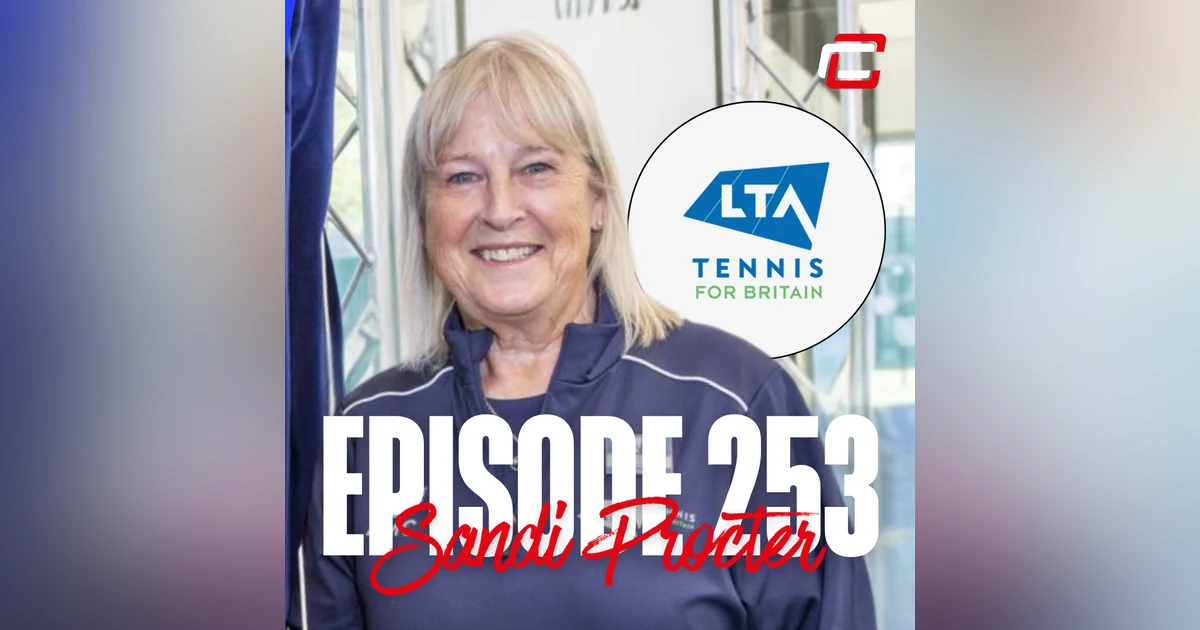
LTA President Sandi Proctor on Mini Tennis, Developing Young Leaders & the Role of Federations

 Apple Podcasts

 Spotify

 Overcast

 Castro

 RSS Feed
In today´s episode, Dan speaks to the President of the LTA, Sandi Procter.
Sandi shares her journey from a PE coach to a leading figure in British tennis. She was instrumental in introducing the now world-wide mini tennis red, orange and green system, as well as the LTA´s Tennis Leaders programme.
Sandi also discusses the importance of empowering women in tennis and the need for adaptability in coaching. Sandi is a brilliant example of where the sport of tennis can take you, and how you can inspire others. Enjoy!
Episode highlights:-
🎾 What inspired Sandi to come up with the red, orange, and green balls system which has transformed mini tennis.
🎾 How she found love through tennis and how it led to her unexpected transition into coaching.
🎾 How empowering young leaders in tennis is crucial for the sport's future.
🎾 How technology is reshaping how tennis is played and coached.
🎾 Can tennis coexist with emerging sports like Pickleball and Padel?
🎾 Sandi´s vision for the future of tennis and the importance of community involvement in the sport.
Links Mentioned in this Episode:-
- Follow Sandi on Instagram
- Watch the "best mini tennis point ever"
- Follow Control the Controllables on Instagram to keep up with all the latest on the show!
If you enjoyed this episode, please take a moment to subscribe and leave a review on Apple Podcasts! Your support helps us reach more tennis players, coaches and parents who need these insights.

Episode 253: LTA President Sandi Procter on Mini Tennis, Developing Young Leaders & the Role of Federations
DISCLAIMER: Please note we use a transcription service, so there may be some errors in the following transcript for the episode. If you can, refer to the audio for the exact quotations.
Dan Kiernan (00:09)
Welcome to episode 253 of Control the Controllables. And we've got what was the PE teacher, all of those years ago, to now the president of the LTA, in Sandi Procter. And it's a guest I've wanted on for quite a while. You know, Sandi actually approached me back at Wimbledon in 2024.
And this sums up what I love about Sandi. She came up to me and said, oi, when am I... when are you gonna get me on your podcast? I listened to Sue Anstiss and I thought it was fantastic, and I'd love to come on. And yeah, that was an honour for me, that Sandi had spoken to me about coming on.
Now, ever since, we've kind of tried to get this conversation going. She's an extremely busy woman, you know, as you can imagine. The presidency of the LTA, lots going on. And I've got one or two things going on myself as well. So to match up the times wasn't so easy. But I loved the conversation with Sandi.
I think it's so nice to get to know someone... you think, sometimes, an LTA president, you think that it's gonna be hard to be able to connect with them. But just to have that human side of that role, and of that organisation, right? You know, certainly in British tennis, there's a lot of kind of negativity, or the letters LTA, we look down on it, wrongly, you know.
And to be able to get underneath that, and to understand the people that are involved, and the thought processes, and everything that is going on... it was an absolute honour for me to speak to Sandi, and it's a privilege for me to pass that over to you guys. So, over to Sandi Procter.
So, Sandi Procter, a big welcome to Control the Controllables. How are you doing?
Sandi Procter (02:05)
All right, thanks.
Dan Kiernan (02:07)
Thank you for coming on. You know, what an honour to have the president of the LTA on little Control the Controllables. And I've been trying for a while. We've both probably not had the easiest schedules to get together, but a big thank you. And, to start with, how are you? How's things?
Sandi Procter (02:26)
Yeah, things are really good. Things are really busy, and, of course, getting even busier as we head towards the summer. But all good fun. I'm enjoying the role.
Dan Kiernan (02:36)
And is that how it tends to get? Is it a busier role as the tournaments start to come to the UK? What's the... how's the kind of spread of that work across the twelve months?
Sandi Procter (02:49)
Yeah, it's pretty spread all year round, with different types of events, and obviously international bits as well. So pretty spread. But it really heats up come May, from the French Open, through the major events, through the summer here. So yeah, it's non-stop all the way to the end of Wimbledon.
Dan Kiernan (03:11)
Well, with this conversation, I'm sure there's lots we're gonna jump into. You've had a wealth of experience, and I'm sure memories, and challenges, and many, many things in your life and your world that have, I guess, led you to this position as well.
And then I'm sure we'll also jump into... I always, when we hit the LTA... we, in Britain, we love to say it in such a negative way. The LTA did this, and the LTA did that. So it's gonna be great for me also to be able to just open up on some of the messages, and the things that are happening, and the hard work that goes in constantly behind the scenes, and the opportunities that are open.
So we're gonna jump into some of those things. But, as ever on the podcast, tennis is our connection, right? That's what we all love. And I'm always so interested in people's stories, and how that starts. So, if you go back... I know it wasn't that long ago... but when you were younger, or go back, where did tennis start for you? Where did the bug get stuck in your system?
Sandi Procter (04:18)
I suppose it was a sporting bug more than a tennis bug, to start with. I'm of an age where we didn't specialise much in sports. We just did. In fact, my best sport at primary school was football, but I wasn't officially allowed to play, and had to have my hair cut short and dress like a boy in order to play.
Dan Kiernan (04:39)
Incredible.
Sandi Procter (04:39)
But then, when I got to secondary school, of course, I was in sports heaven. So I played every sport imaginable, including tennis. Lacrosse was my favourite, netball, all the summer sports, and then tennis was in the mix.
So I wouldn't say that I got a tennis bug on its own. I didn't come from a family that could afford a tennis club or anything like that, but I played in the school team. So that's where my love of tennis, along with other sports, started.
Dan Kiernan (05:12)
What was it eventually that did attract you to tennis?
Sandi Procter (05:16)
It's a bit of a romance story, actually. I became a PE teacher, and I was coaching, or teaching, in a school in Ealing, and decided to join Ealing Tennis Club. And when I had my playing-in test, as you did in those days, I met a man who ultimately became my husband, and he was a bit of a tennis player.
So we met on playing-in test day, and he was... he played at junior Wimbledon, and was good. And thereafter that, yeah, I played loads of tennis.
Dan Kiernan (05:47)
There's the name of our podcast: Fifteen Love. You know, that's brilliant.
Sandi Procter (05:50)
Yeah, that's...
Dan Kiernan (05:50)
And when you reflect back to some of those early tennis experiences... because you'll have some... obviously, you sounded like you had a great experience when you started your tennis, your tennis life. But there are varying degrees of experiences that people have.
We'll jump into that maybe with padel and pickleball a little bit later, because I think that's maybe one of the challenges that tennis has, against up-and-coming sports like that as well.
How has that maybe inspired you, later in life, to be someone then who has... I know you're the president right now, but you've been involved with the board, I believe, at the LTA since about 2017. So you've clearly got leadership skills, you've clearly got a passion, and something that you want to make a difference with. You know, what are those early reflections that have inspired you to want to do that now?
Sandi Procter (06:46)
Well, I think really through becoming a coach, to be honest. So, when my husband's job... he worked in oil... started moving us around, I couldn't teach in schools. I call myself the accidental tennis coach, to be honest.
Because we were in Aberdeen, to start with, playing at Cults Tennis Club there, and there was no coach in the whole of Aberdeen. And I was a PE teacher who could play tennis. So the parents landed on me and said, would you coach our children? And so that's how I became a tennis coach.
And it's through coaching that I've become more and more interested in the sport, probably more than playing. I mean, I have played, and I've played county, lower county tennis, but it's really been through coaching that my love of tennis has absolutely flourished.
And all the way through my coaching, I've been a volunteer, and I've helped run tournaments and open days. And then I've gradually got into the whole volunteering sort of part of things. And then I also got involved in the administration side of things. So I started running my own programme in Aberdeen.
And then my husband's job moved us to Dubai and Cairo. I was the only female coach in Dubai, by the way. And I ran my own programmes there, and equally in Cairo, a bit less so. And then I travelled around a bit, ended up in Beckenham, and went to the Park Langley Club in Beckenham, and later to the Bromley Tennis Centre.
And at both of those places, you know, my love for nurturing just young players in particular... I became very, very interested in the whole ten-and-under age group, particularly for my own coaching, but then with following them up, and moving them on to other coaches, and managing their programmes. That's where my love of it all has come from.
Dan Kiernan (08:52)
Great. It's interesting, you're saying you were almost the only coach in Aberdeen, but you were the only female coach in Dubai. So who was helping you? You know, did you do coaching courses? Did you have any mentorship? Was it just all learning on the fly?
Obviously you had the organisational skills from your PE teaching days, and the ability to keep discipline and run a session, you know, those things. Who was able to give the more technical knowledge and help develop in that area? Or was it just learning as you went?
Sandi Procter (09:24)
Yeah, a bit of both. But, obviously, while I was in Aberdeen, I managed to do my LTA qualifications. So I did one, two and three while I was up there in Scotland. And so that's where I'd have got my kind of slightly more formal technical input, through those.
And then, in relation to kind of the administration and programming side, I tell you what, I think I just learned along the way, on my own. There were no courses in those days for how to run a good programme, or how to do your administration, or set things up.
I started small, and then I just grew things, and I just did whatever I thought was right, really, by kids playing, and getting them playing, and running the programmes.
Dan Kiernan (10:11)
Having that experience in various countries... I would imagine Dubai was a very different country then than it's turned into now.
Sandi Procter (10:19)
Yeah, yeah. Well, we're talking the eighties. There wasn't a single high-rise building, nor a grass golf course. And I was coaching at a hotel, and also an expat country club. And, yeah, the kids were madly keen. I also taught other sports. I did a lot of squash coaching as well, and swimming, and all sorts of kids' activities.
I coached adults as well, but it was always coaching kids that I liked the best. And I suppose that was my sort of teaching background that helped that, really. So yeah, lots of interest around, overseas.
Dan Kiernan (10:55)
And did people frown upon you being a female coach in Dubai in those years?
Sandi Procter (11:01)
No, no. I think probably because mostly I coached expats. So, no. But I did coach a number of local Dubaians. In fact, I did coach Mahesh Bhupathi for a little while, whose parents were there. But he was only 10 at the time, so I can't claim a whole lot. His dad was a really good player, and his dad did most of his coaching, but Mahesh came to my group lessons. So I had a lot of different cultures who used to come to my sessions.
And then, yeah, coaching local adults, Dubai men, was very different. They really just wanted somebody to hit with them. So, you know, somebody who could keep rallies going. And I just had to learn, roughly, to take individual requirements. I suppose we're all doing that now, aren't we? We all coach people as individuals, not all the same.
And so I used to have to, to a certain extent, understand what input they wanted. Did they just want somebody to hit with? Or did they genuinely want somebody who would actually help them with their grips, their swings, their footwork, or whatever? And they were all different.
Dan Kiernan (12:14)
Yeah, 'cause the reason I ask... I was at the WTA Finals in Riyadh in November. And I guess, just in my head, I maybe think of Dubai in the eighties being a bit more like maybe Saudi is now, or Saudi has been over the last few years. And that needs trailblazing people, you know, to make a difference.
And that seems to be a bit of a thread through your life, that you've kind of played little trailblazing roles, you know, even in the position now. I know Cathie Sabin, the late, great Cathie Sabin, was before you, as the first female president of the LTA, but, you know, you're taking that torch now as well.
And it was just so interesting for me to see... I've become quite fascinated, actually, with the whole Saudi thing, and now what's gonna happen with the WTA Finals, and how they're gonna grow on that. You know, and having conversations with the locals, and understanding the changes that obviously need to happen, and are maybe starting to happen. But are they really happening, or is it just a little bit in front of the media?
And, you know, actually having real people do these things... and, you know, one of the most common things I probably ever say on the podcast is, you have to see it to be it. You know, and did you find, as you were doing that, that it then encouraged other women in Dubai at that time? Or was it just your circumstance, and that was maybe something that started coming a little bit later?
Sandi Procter (13:38)
Yeah, I certainly didn't see that in Dubai in those days. You know, the majority of people playing tennis at that time were expats. And so I don't think I remember seeing that other people became coaches. I don't think many people were interested in playing.
I hope that some of the youngsters that I coached in Dubai might well have gone on, when they left Dubai and went on to wherever they went, and might have been more interested in that.
And certainly I had a few helpers, mostly mums. I think, all the way through my coaching, I've never been afraid to ask the mums to help me. And partly because I knew they'd quite love it. But, you know, if I ran little competitions for the kids, or I wanted to do some fun sessions, or I wanted help with some feeding, so the kids got lots, I was never afraid to ask the mums to step on.
And it was mums in those days, largely. But later on, at Park Langley, it probably would have been mums and dads, I don't mind. I'm quite bossy, so I don't mind getting a few people to come and help me.
Dan Kiernan (14:47)
We've gotta be, as tennis coaches, to control the herds. But talking about trailblazing, and talking about your love of under-ten tennis, you know, and that's obviously been a big area that you've been involved in... you were also heavily involved with the ROG, the red, orange, green, that was developed.
And, you know, back in my day, it was short tennis, the plastic racket and the fluffy ball, and then we moved into that. So how did the idea of red, orange and green come up? And tell us about the role that you played within that.
Sandi Procter (15:27)
Short tennis is what I did first, actually, Dan. Same as you. So it was when I was in Dubai that I read in a British tennis magazine that short tennis had arrived in the UK from Sweden, and I thought, I've absolutely got to have a piece of that. I ordered a bag of Slazenger equipment, it came over to Dubai, and we had a sports hall, and I was in heaven with this.
And it meant that I could suddenly start coaching younger children, the younger brothers and sisters of kids that I was already coaching. So, to be honest, I thought that was probably the biggest revelation in this area. And all I helped to do was love it.
And then, in my next moves, around Lincolnshire, Aberdeen, back to London, I was discovering a bit of a problem. You probably had it as well, which was: it was all very well, the kids could play a great game with a plastic racket and a sponge ball, but when they moved suddenly from there to a tennis ball, it was too much of a jump. And we were losing a lot of the kids that were loving to play that, because we moved them up.
And there was a little bit, in those days... a lot of the kids would carry on playing short tennis until they were nine or 10, because the jump to a yellow ball and a big court was just too much.
And so I had, with my team at Park Langley... we'd grown the programme there to around 2,000 players a week on a coaching programme, which is enormous. And 800 of those were under-eights playing short tennis. So, I don't know, I don't think it's still that big, but in those days we had all the school sports halls available as well.
So, because it was such a notable programme, and 10 of our kids were picked for a sort of Future Stars programme by the LTA, Roger Draper said, what's going on at that club? I want to know, because we need to sort out the sponge ball through to the yellow ball.
And so I was asked to go to the LTA and almost do a bit of a project, along with Phil Veazey, who was head of development in those days, and a team, some of whom you would know. It was with Mike Barrell, Mark Tennant and Jenny Thomas. So we got our heads around it, and I went and looked around the country, to see who was doing a good job on the short tennis front.
And by then some softer balls had come in from some of the companies. They were called Transition, or Low Compression, or Evolution. And we all got together, and we all decided there were three stages, we thought: the sponge ball stage, and then a slightly softer, slightly bigger court, and then another stage. But none of us knew what to call it. So we all wrestled with all sorts of names.
And then, on the way back from a meeting, I was on the North Circular Road, crossing with the Finchley Road, and I was stuck forever at some traffic lights. And I went to myself, that'll be it: red, orange and green. Perfect.
So I got back to the ranch, talked to Phil about it. He said, brilliant. We took it to Roger Draper, and Roger will kill me for saying this, but he said, Sandi, is that a bit complicated? Red, orange and green. So I said, I think every kid is either on the road, on their bike, walking, crossing the road. So he said, go for it. And we went for it. And that's how the name red, orange and green came up.
The biggest problem was it would only work at the red stage if clubs had access to indoor courts, because the sponge ball is hopeless outdoors. So we needed a sort of outdoor version of it.
So Phil and I went to all the manufacturers and said, we've got an idea. Here's the sponge ball. It's very successful. And now we'd like an outdoor version of this. So we think a felt-covered, same sort of size, would work really well. Well, you've never seen them all run out of the room faster than they did, because they didn't want to know.
But who stayed behind was a lovely guy called Derek Price, of Price of Bath. He said, I'll give it a go. And he went back to his factory in Bath, and he made about seven attempts till he got to the right one. And that's what we then launched red, orange and green with. So he was the first person to sort of create that ball.
And look where it is now. You know, it's all around the world. Everywhere I go, I see pictures and activities where kids and coaches are using the red ball. It was all invented in this country, and thank goodness Derek was willing to do it. And, you know, he's in his nineties now, and he still works on his factory floor every day, or six days a week, or something.
Dan Kiernan (20:41)
A big shout out to Derek. Incredible. You say it's everywhere. I was in Miami a couple of weeks ago, for the ATP/WTA tournament, and Aryna Sabalenka, who some people might know... she plays okay at tennis... she was using a red felt ball.
Sandi Procter (21:01)
Wow.
Dan Kiernan (21:02)
And she was working... and I think this is one I'd love your thoughts on, Sandi, because I've got a saying: it's a tool, it's not a trophy. Because they're very much... and my kids have gone through that system. They play tennis, and I've got three kids, and them coming home celebrating that they've used a green ball, as if they've just won a tournament...
You know, and it's like... I'm constantly trying to explain to anyone that will listen: it's just a tool, to help develop your tennis, or to have fun playing tennis.
Aryna Sabalenka was very much using it for the purpose of trying to drive through the forehand more, and have the different resistance. So, you know, for her to drive her forehand down the line. And I've used it with players, if I want them to extend on their backhands, you know, pro players.
And then the feeling of doing that with the red ball, and then throwing in the yellow ball, so you then try and follow that. Just a form of resistance training. I think it's a very clever usage of it.
But also we're starting to see adults use it, and adult programmes being used, and it actually playing the game, right? Because I think that is one of our biggest challenges. And I've lived in Spain for 15 years, where padel is a massive sport, and obviously padel's starting to get bigger now in the UK. Padel is quite easy to play.
You know, and you can get different levels to come out and play the game, and four players can have a really fun game. Tennis, it's quite a difficult sport to play to a level that's worth playing, you know, and to have rallies. Whereas it seems like using the different compressions of balls, and being smart with the tools that we have, could make the game a lot more entertaining for players as well.
Sandi Procter (22:54)
Yeah, I think, you know, what you said about trophies, and kids getting really happy because they've moved up... I think, particularly when we first started... I think it's a bit better now... there seemed to be a real enthusiasm to move up. Now, that could come from kids or parents.
And I think, to start with, kids were just moving up too quickly, and perhaps sometimes just because they'd reached a certain age, rather than they'd reached a certain ability. And I think sometimes there's too quick move-ups for some of the kids. You know, it just ruins the actual playing of the game. If they can just hit a few balls over the net, that's not a sign that they're ready to move up to the next level.
I think you're right. I think the adapted equipment can be used much more generally. When we launched it, it was for kids, and we marketed it... and we look back on that now, and I certainly wish that we'd marketed this as just a way of playing tennis and learning tennis for everybody, of all abilities.
Because now we know that, A, this is a great way that a lot of teenagers and adults would learn the game. But, B, it's more of a framework than a journey. So you could play any one of those. I'd be perfectly happy to go and have a really good game of red.
And in the States, at the moment, they've got Red Ball for All, which is encouraging people to go out on a small court, like a pickle court, and just use a small racket and a red ball, and have fun. Because the feel of a ball on racket strings is just lovely.
You know, if we'd marketed it like that at the beginning, it wouldn't be quite such a culture that it's just for kids. But, you know, Dan, one day we will get there. We will get there, that everybody will realise that it wouldn't matter what kind of tennis you could play. You could play red on a small court, you could play orange on a medium-sized court, green. And no matter what your age, find the right thing for your ability, and have fun.
And I wish a lot more adults would enjoy playing with a green ball. And I do... I suggest this when I go and visit clubs, and I see adults having a nice social morning, but their rallies aren't more than three shots long. And I go, if you used a green ball, you'd get more exercise, you'd have more fun, you'd have more rallies. And, yeah, it'll happen one day. We'll have it. And some people are doing that really well. Some coaches are doing it very well.
Dan Kiernan (25:45)
If I take it back to the junior development piece, around red, orange and green, what do you think the hardest transition is between those balls, and then into yellow? Which stage?
Sandi Procter (26:01)
What do I think? I think probably the red to orange is probably the biggest jump, because it's the biggest court size jump, and probably the biggest ball movement jump. But I don't think it is all that difficult, as long as it's not done too soon. But I think, if it's done too soon, it is the difficult one.
So the other two are a little bit more gradual. But, again, if you jump any of them too quickly, they can all be too much. I would settle on red to orange being the biggest change.
Dan Kiernan (26:40)
Because they say... they, whoever they are, more intelligent people than me, people that have studied this... the most similar to professional tennis, in tempo, balls hit per minute, you know, the tempo that the ball's coming back to you, directional changes, they say is orange ball tennis. So the best players in the world on an orange court will probably have a similar rally tempo to Carlos Alcaraz against Jannik Sinner.
Sandi Procter (27:16)
Oh, wow, that's incredible.
Dan Kiernan (27:18)
They've overlaid that. Whereas, once you move on to a full court with green ball, you're now getting into defending again. You're kind of almost changing the tactical intention, you know. Because there's the famous Sonay Kartal and Emma Raducanu video, that, you know, where it's young professional tennis players playing, right?
And there's a lot of movement of the ball, and offence and defence, and changing direction, and turning the point around.
Whereas, once we send them on to the full court... and one of the most powerful coaching education days that I had, they put us all, as tennis coaches, on a full-size court, times fifty percent. And they made the net 50% bigger. And they said, this is what it's like. This is what it's like for a 10-year-old, who's about 50% of what they're gonna be, size-wise. This is what it's like for a 10-year-old playing on a full court right now.
And, from a tactical standpoint, there was no intention I could have, other than just get the ball up and over the net, you know? And I remember that was quite an impactful way of doing it, and feeling it, actually. Which is... it's been very, very clever. It's amazing that you've been such a big part of that.
Sandi Procter (28:31)
That's really cool. I think the description I often used, when I was doing coach ed, was whether the children are coping or playing. So, if they're simply coping and, as you say, defending, they're not really playing the game. And you're right, that's the Sonay–Emma rally. There's another rally you can see on YouTube, called the best mini tennis point ever.
Dan Kiernan (28:57)
Right, okay.
Sandi Procter (28:59)
And I filmed it. It was a coach who put it on, called Matt Healy, who knew how to put things on YouTube, whereas I didn't, because this is way back. And it's two boys, same age as Emma, because Emma was on the next court. I actually filmed both Emma's match and these boys' match.
And the boys played the same sort of rally as the Sonay–Emma one on orange. They played on red, with every shot you can imagine: overarm serve, using the whole court, go to the net, lob, passing shot, and everything. And it's the same sort of thing. It's, you know... if you blur your eyes, you think you're watching pros.
And I think that... I mean, not every kid's going to be that good, but you can get that good in red, and then you can get that good in orange, and then you can get that good in green. And I wish we'd let the children get that good before they rush up too fast to the yellow.
Dan Kiernan (29:59)
Well, there's gotta be no better way of developing than playing the game the way that the game is played.
Sandi Procter (30:05)
Yeah, yeah. I'm big for playing the game all the way through, rather than learning endless forehands, endless backhands. You've got to have everything in situ, and serve, rally and score, as the ITF campaign said.
Dan Kiernan (30:21)
Absolutely. And to move you into one more thing that I think is brilliant, that you've been a big part of: the LTA Youth Tennis Leaders programme. And what I love about that, and I would love you to tell us a little bit more about it, is... I guess it's my philosophy, really.
You know, at SotoTennis Academy, my whole aim has always been for us to impact people's lives through the vehicle of tennis.
You know, and we know that some people might end up on the big stages, but we also know that this sport brings just so many incredible skills, and networks, and experiences, that are so transferable into so many different forms of life.
You know, whatever that might be... whether that might be your relationship with a partner, your relationship with family, you know, down to friendships that you've got, or jobs and roles, and all of these different things. And I think anything that shines a light in those areas is something that we need to do a better job of, and educate better, for our sport. So tell us a little bit more about that as well.
Sandi Procter (31:28)
Whenever I've been coaching... you know how I said earlier I'm pretty bossy and got all the parents involved... I used to also spot teenagers. I'd perhaps coach some teenagers, and I used to ask them if they'd like to come and help me with the little kids. Now, I didn't call them leaders, you know. They were just my helpers at the time.
And when I was at Park Langley, and we had a big programme, we actually formalised the teenage helpers programme, and we gave them little training sessions, and they used to come along. Because, if you've got, as I did, 14, 15, 16 kids in a class, the most valuable rally that most of the kids are going to have is with the coach.
Well, if I've got four people with me that can all rally really well, then the little kids get more rallying experience, more hitting experience.
So, when I was at the LTA, and I'd rolled out the red, orange and green, and there was a case of, right, what next? I said, I would like to create a formal Tennis Leaders scheme. And we worked alongside the Sports Leaders people, and the Youth Sport Trust, because there's a generic Sports Leaders course.
And we created a Tennis Leaders course specifically for the tennis kids, but bringing in some of that stuff. It's all about organisation, communication. The kids don't have to be good tennis players. They're there to help a coach, or help a referee at a competition. They learn scoring, they learn feeding, they learn just how to organise the little kids into activities, how to help them.
They don't coach, but they do pass on what the coach has told them to pass on. And, of course, that's growing our own workforce, for coaches and officials, for the future as well.
And so we formalised the programme, and it's now been going since 2007. It's on its third sort of update. It's had three to 4,000 teenagers, aged 11 to 16, go through this a year with the LTA. I say with the LTA... it's delivered locally, by coaches and teachers. Very school friendly, you know: a two-hour introduction module with the basics, and then lots of little add-on modules.
I think it's great. I think it may be underused. I think we've got an opportunity to keep these teens in tennis, but in a different aspect of tennis. We've got an opportunity to give them the life skills.
The parents of the kids that used to be my leaders loved me, because I had the kids working on holiday camps and in the evenings. Far better than going and stacking the shelves at the local supermarket. And they were learning life skills and confidence.
Some of these kids... I can't tell you how some youngsters would come to me shyly, saying they'd like to be a tennis leader, or I'd pick them out. And in six months they were talking at the top of their voice, organising 20 children.
And many of them went on to be coaches themselves, or PE teachers, or teachers in general. I loved developing, or helping those teens to develop, almost as much as the little under-eights and their tennis skills. It was lovely. Yeah.
Dan Kiernan (34:57)
Amazing. Well, one of our performance behaviours at Soto Tennis Academy is: pay it forward. And that kind of runs through the academy. Again, we don't have an official tennis leaders, but that's basically what it is. And we actually have a lot of the players almost fighting to come to the mini tennis sessions.
And one of the real side effects, positive side effects, I've seen of that is that their game intelligence improves, and their own performance improves as well. You know, because all of a sudden they are teaching something that someone has tried to teach them, and maybe it's not quite sunk in, you know.
But all of a sudden you can see that they're having these conversations, and they're starting to bring these things through.
You know, we'll encourage, like, big buddy, little buddy systems. You know, we'll encourage players to talk to each other about their own match plans, before and after, you know, and have these discussions.
And I do think that kind of teenager, who does naturally lack a little bit of confidence... by them almost becoming a bit of a master of that skill, by being able to teach it themselves, it has quite a profound effect, in terms of then the development of them as tennis players as well.
You know, and I just think there's so much good that can come from all of those little things. And we just need cultures to continue driving those things forward, right? You know, within clubs, within academies, within centres, whatever it is.
Sandi Procter (36:32)
We often hear it said, don't we, that if you want to learn something really well, then teach somebody else. Do your kids do Tennis Leaders? Have they done it yet? Are they old enough?
Dan Kiernan (36:44)
So, in Spain, we don't have that official thing, I guess. Yeah, well, I guess we kind of do. I actually set up... I call it the B Kool programme. And it's spelt 'cool' the cool way, with a K. And it's the whole concept... it's all about keeping options open for life.
So, in that programme, we're doing lots of little things, where there's lots of those skills, and just bringing awareness to different things. We do a lot of stuff with our players on getting them also to work in groups, focus groups, and then present. Often they don't know what we're doing, but we're trying to give them experience in all of these different areas of life, you know.
Of, you know, coming together as a team and researching a certain topic. It might be researching something to do with... we do, like, a lot around, like, realities of the sport. Research players' records, and get them to understand how much players actually lose in our sport.
We can't get too upset when we lose, because the best players are losing all the time. But they then have to bring that through and do that presentation in front of people.
You know, I think all of these... we're constantly trying to think of these different areas. Because, yeah, I think the sport of tennis gives just a massive opportunity for that, really. And, you know, I think, for me, and where I've got to in my life: tennis is the best sport in the world. It's an incredible sport, you know.
And the reason it's incredible is because of all of those things it brings, you know, and all of the people that are involved, and the people that you meet, and, you know, the travel. I just bumped into someone in the lobby here in Barcelona... I'm here at the ATP tournament in Barcelona... and he was on my county team back when I was sixteen. And he's here 'cause he's playing the over-45 ITF event, twenty minutes away.
I feel very lucky to come to these tournaments. But one thing I love about it is, I can almost guarantee I'm gonna bump into someone... he's making his living through doing tennis camps, and he does tennis holidays, or tennis experiences.
And it's like, you know, we don't set about thinking of that when we're playing red, orange and green, you know. We're only thinking about being Emma Raducanu or Andy Murray. You know, but actually it does trend off into lots of different areas.
One question I'd love to ask you: Do you think we do a good enough job with that messaging, actually? Of what success looks like, or can look like, and, I guess, the various levels and layers of what success through tennis, and that vehicle of tennis, looks like, you know, from a young age?
Because it feels to me that we get a lot of disillusioned parents, that maybe feel they're being sold, to try and go a professional route. And then, well, that's not possible, or we're not able to do that, or we don't get this, or we don't get this funding, or that's not... and then they almost fall out of love with tennis. Could we set the expectations better, and have our messaging better on that?
Sandi Procter (40:02)
Yeah. Do we do enough? We do a lot, but we could do more, I'm sure. All of these things, I reckon, start at a local level, really. So with coaches and the kids. And if coaches can offer their players a wide variety of ways to be involved in tennis, of course that will help. The message is quite difficult, because all this happens at a local level.
What we do do, at a kind of national level, is that we have things like the LTA Tennis Awards, and one of those awards is for Young Person of the Year. These people are recognised. They're nominated by their clubs, and then there's a county winner for Young Person of the Year, and then, indeed, a national one.
So I think there's some good things that we do. But there's no doubt it could go way wider, and help the players and the parents realise there are way more ways of being involved in tennis than just being the next Emma Raducanu, Jack Draper, or whoever. I think we could do more. And certainly I've seen, at a local level, keeping kids involved that would have given up, for sure.
And, going back to knowing that you'll meet somebody in the lobby or somewhere... you can imagine, now, at my age, how many people have gone through my books, if you like, and I've looked after them on the way. How many times I meet players that remember me.
So, even people like... it was really funny when Emma took on Nick Cavaday as her coach, because I coached Nick Cavaday, and he was one of my first ones at Park Langley. And equally Naomi Cavaday, Nick's younger sister, is now a commentator, so I hear her on the TV constantly.
So, you know, I have huge pride in bumping into not just those players who have done well at the top of the game. But occasionally I'll bump into players, or people... And because I've been on TV presenting the trophies at Wimbledon, people have found me now on LinkedIn, people that I'd taught once upon a time.
And I've been tracked down now by kids that I taught at secondary school in Croydon, many, many years ago, and caught up with them. And, you know, what they say to me is that I made a difference to them. And, you know, that makes me more proud than anything, really.
And I think we've all got a job to do, talent spotting. But not just talent spotting for being a good player, but talent spotting for the other things that tennis can offer you. Like being a leader, like being a coach or an official, like the things you can do in the future. I think we've all got a job like that. We must do it.
Dan Kiernan (43:07)
It's really well put, Sandi. Really, really well put. And look, people aren't gonna track you down... well, unless it's for a bad thing... they're not gonna track you down unless you have had an impact, you know. So you should be very proud of that as well.
Now, the last bit, to move you into, is your current role. You know, current role as president of the LTA, which, again, is an amazing role. I'm sure a big responsibility, you know, something that you can be extremely proud of.
And I guess my first question I'd love to ask you on this... and I've had this discussion with lots of people over the years. I mentioned off air, this is kind of our five-year anniversary as a podcast. So we've been going for a while now, over two hundred and fifty conversations, you know. And I always like to explore what the role of a federation is in tennis.
You know, and I think it's always quite a big question, you know. And, certainly, being a Grand Slam nation tends to be even more responsibility, because of just the magnitude of what goes into that. And I know that the LTA is not Wimbledon... Wimbledon's not the LTA's tournament, as such, but there is obviously a link there.
So, in your position, what would you say the role of a federation is in the tennis ecosystem?
Sandi Procter (44:28)
Well, it's very, very wide-ranging. I mean, we govern the sport, is our official role. But that means govern all aspects of the sport, and promote all aspects of the sport. So, gosh, we do such a lot, really, all the way from simply its rules. We don't do the rules of tennis, the ITF does, but certainly we have our own rules, and our structure of people that are out there.
We've got, you know, a paid staff, led by our CEO, and a shout out for Scott, really, because, since he's been in, we really have had fantastic success at all levels of the game. Participation is up, higher than it's been for a long time. More players in the top hundred. More success at Billie Jean King Cup, Davis Cup. It's been a very exciting time for me to be president, I must admit.
What has he brought to us? Well, he's brought to us that we're responsible for a wide range of things. So he brought in a vision that we would have tennis opened up. And what that means... and a lot of people really know that this is our vision... it means that we're trying to take tennis to as many people as possible, including people who would never believe that they could play tennis, or would ever have the opportunity.
So we have fabulous programmes out there that take tennis into disadvantaged communities, communities that are not the kind of usual communities. Maybe taking tennis into mosques. The Kent Tennis Association, they've got tennis activity in a Sikh temple in Gravesend. They've got more programmes in youth clubs.
We've just refurbished 3,000 parks. So we've got massive growth in tennis players just turning up to their local parks and playing. We obviously do things like provide coaching, training and education for coaches, for officials. We help local authorities with looking after their facilities. We help clubs with looking after their facilities.
We provide... gosh, I'm not going to get stuck, you know, for about the next half an hour on this, so I'd better sort of... we provide volunteers with all the support resources they need. It's so across the board. Wimbledon run the Championships. Well done, they do a fabulous job, and that's over there.
The surplus comes to us, and that helps us run the game. And we run almost every aspect of the game you could ever think of.
Dan Kiernan (47:20)
What's the most rewarding part of your presidency so far?
Sandi Procter (47:26)
I would say the people I meet. So my role is... I describe it often as threefold. I represent the LTA internationally. So I go to the Grand Slams, and I represent them at the ITF and Tennis Europe. And I'm on the Tennis Europe Board of Directors as well.
And then my second one is that I run something called the LTA Council. So I'm their official leader, but I'm really one of them. And we just work together, and we filter information down, through our councillors, down into the counties, who filter information down within their counties, alongside the LTA centrally.
And the third thing I do is, sort of domestically, I'm classed as the most senior volunteer in tennis, and I support volunteers, and champion volunteers, and present awards to volunteers, and try and make sure that volunteers everywhere are being looked after as best they can.
And my favourite bit is those volunteers. And I meet them through awards, and through when I visit clubs and counties. I meet the most amazing people that you could imagine, that have given years, even decades, to helping other people play tennis. And it's an astonishing passion out there, amongst people who want to do that. And that's been my favourite bit.
Dan Kiernan (49:00)
And that's an energy to keep you going, if there ever is one.
Sandi Procter (49:03)
Completely right. Yeah.
Dan Kiernan (49:06)
And, in terms of... I touched on it before, you know, the late and great Cathie Sabin. I loved, loved Cathie, you know. And you now being the second woman in history in this role... you know, that's obviously a massive part of sport that we need to continue driving and pushing.
You know, on the podcast, we had Sue Anstiss on, relatively... you know, we had a big, big discussion. We've been trying to push, you know, Empowering Women weeks on the podcast. We've talked about the WTA... you know, there's so much scope for us to do a better job.
For you personally, you know, how does that feel? And what does that mean for the future of leadership, in roles like this, that you're able to champion that for women moving forward as well?
Sandi Procter (49:55)
Well, I'm delighted you brought up Cathie, because she was very much a mentor for me. She was the person, really, who encouraged me to even put myself forward, in the first place, to the board, and then deputy president. So I have a lot to thank Cathie for.
And yes, I decided, when I became president, that one of the things that we needed to address was not enough females at the sort of decision-making level. And certainly we're not bad on the LTA Council, but we're only about 21 out of 53. So it's not enough. And around the country, something like only 27% of our member organisations have female chairs. And I thought that was something I could make a difference with.
And I was also part of an ITF Advantage All programme that was led by Katrina Adams. Do you know Katrina? She's ex-USTA president.
Dan Kiernan (50:56)
Okay, yes. So that's what came to my mind, was the US.
Sandi Procter (51:00)
She led a programme to try and, you know, encourage, across leadership, more gender equality. And I learned so much by being on that programme, largely through COVID, and online sessions, and podcasts, and meeting people like Billie Jean King, and Katrina herself. And Sue Anstiss has been amazing.
I actually started up a programme called Inspire, for women volunteers. So I worked with Vicki Williams, who's at the LTA, and they had an Inspire programme for colleagues, on leadership. And we remodelled that, along with the ITF Advantage All stuff, to create a course for women volunteers. Very easy: six to seven hours a month, an online session once a month to motivate. It takes a year, and it's been great.
And then they've gone on to help nurture the second group, which we've just finished, and we're hoping to maybe scale that up, and get that out there a little bit more, and maybe get more younger women into it.
These Young Person of the Year awards that we give... a lot of those are girls. And it would be great to nurture them further, as future volunteers and as future leaders. So, yeah, I'm all for that, and I've loved doing that, and I've seen that make a difference to some women. It's been great.
Dan Kiernan (52:27)
What about the coaching workforce? Does that remain a challenge? I know there's been programmes, I know there's been pushes. I certainly see it on the coal face, at academies. We don't get many applicants, you know, from female coaches. You know, that's maybe a little bit different, obviously.
That's maybe requiring a move to Spain. But, you know, on the ground, are we starting to see that coming through more? If not, what can we do to continue?
Sandi Procter (52:56)
There's two things to it, I think. There's one, the coaching workforce, which isn't big enough to cater for what we've got. And the other is what proportion of the workforce are women.
So, on the size of it, we've actually got more registered and accredited coaches at the LTA than we've ever had before. But, because we've got more participation, it's still not enough. So we're continuing to drive, to encourage people to coach.
So we can nurture them through the Tennis Leaders programme, encourage coaches to grow their own, and talent spot these youngsters, to see if they would be good coaches. That would be great.
And then, you know, as an LTA, our coaching team, led by Merlin Van de Braan... I'm pretty sure you know Merlin... you know, they engage with the coaches, provide constant online learning opportunities, and opportunities in general for them.
I think we're doing the best we can, but more still needs to be done, because I hear what you're hearing, which is there aren't enough coaches out in the clubs to, like, cover all the bases. So we've all got to try and do a little bit more, and we've got to try and grow them from younger.
On the women front, yeah, there've been lots of little projects, level one female-only courses, and trying to get more women to recognise that it is a career opportunity. But, more than anything, programme administrators have got to recognise that women can be a really important part of their workforce, but they don't necessarily want to work full time.
We need programme organisers to say, yeah, we are happy that you just do four or five hours a week.
So we need to bring back the... I've been a part-timer on the coaching front all my life. Funnily enough, as a volunteer, I'm far from a part-timer now. But yeah, I think it's making adaptations around the fact that women are largely the family carers, and can give themselves a little less wholeheartedly to the job.
Performance is a tough one, though, isn't it? Because, with the women, only some of them want to travel with players. Maybe more team working, so that they can be a part of a team that coaches a player. But that's a really tough one. I don't have a big reason for that.
Dan Kiernan (55:25)
Well, to be honest, I had this discussion on the podcast last week: is there an easy tennis job out there? No, there's not. In the world... especially once you go into the world of performance, or any real level of competition... the challenge that we have is burnout.
Forget whether you're a man or woman, it doesn't matter. You know, burnout is a real issue, I believe, in this space, you know, the more performance space. Because that tends to attract ambitious people. And ambitious people get attracted to it, but then the pay, versus the hours that you do, doesn't tend to add up.
So you have this massive balance that you're trying to get, or this massive equation, of, like, ambition versus balance. And not just ambition, but also, yeah, the ambition driving you to want to help, and realising, well, that's my opportunity, and if I don't take that opportunity, someone else will. So I need to push, and I need to go to that tournament, I need to travel... and none of us are able to sustain that forever.
You know, so I personally see a lot of burnout happening with tennis coaches. If you then throw in real life, and you throw in, you know, being a mum of two, you know, wanting to, you know, naturally, be a great mum, and take care of different situations... You know, I think... yes, it's 2025, you do get some situations.
I was speaking to Candy Reid the other day, and Candy's awesome, and Candy, actually, she's the traveller, and she's often away from her kids for about three months at a time, and her husband then plays that role. So it can obviously work both ways. But the reality is, whoever the person is that is more stay-at-home, it is very challenging.
The flip side of that, Sandi... and you've mentioned that you have been a part-time coach pretty much all your life... that's also one of the things I've always looked at with tennis coaching and thought, actually, in some ways, it's the perfect mum job, actually.
Sandi Procter (57:31)
Yeah.
Dan Kiernan (57:31)
Because there's not many jobs where you can say, well, actually, I'm picking my own times. I'm getting an hourly rate. And actually, this week, I'm gonna do eight hours, and next week I'm gonna do twelve. And actually, in six months' time, when my kid now starts doing half days at school, I can maybe now do... you know. And I've always looked at it that way.
And, not that I'm... I'm not in the UK, I don't see it so much within clubs, but I would imagine kind of club coaching, it's almost the perfect job.
Sandi Procter (58:06)
Yeah, I agree. It's been my perfect job all the way through my life, so I completely get that. And the flip side of that: having been a programme manager, I needed part-timers. I really needed them, because I couldn't give all-day work, every day, to a team of 20 coaches. But I needed nearly all 20 of them after school and at weekends. So, roll on the return of the part-timers, right?
Dan Kiernan (58:37)
Absolutely. Absolutely, Sandi. Sandi, I could talk to you for hours, but we have our quick fire round, and I have a couple of quick-ish questions before we get to the quick fire round. And that's more, I guess, just impact.
Again, you know, I love tennis, I love talking tennis. I feel very lucky. I get to speak to many amazing people about tennis. It is ever changing. There's lots that's happening. I'm a big one for technology, and different things that are happening, data, and there's all of this.
My first question is: how do you see the role of technology? You know, so it might be AI coaching, online learning... shaping the future of tennis coaching?
Sandi Procter (59:15)
Wow. Well, that's a big question to ask somebody of my age, really. But I'm learning all the time. I did an AI boot camp on Monday, with an organisation called Women Who Lead Sport, because I did a course with them last year, and I've learned a lot more.
So where do I see it? Well, we've got some technology, haven't we? Electronic line calling. We've got data and insights all over the place. We talked about this at this boot camp thing. We talked about how, in the future, in sports, for instance, it might be used more for judging. So, you know, will we end up having electronic umpires, not just line callers? Will we have, you know, a machine on the side of the court for analysis?
At the moment, I haven't got much further than putting my monthly reports, that I write for various newsletters, into ChatGPT.
Dan Kiernan (1:00:10)
Well, you found the...
Sandi Procter (1:00:12)
Don't tell everybody, though. They're so much more nicely written when I've chucked them in there.
Dan Kiernan (1:00:17)
You found the web browser for this link. We'd had a couple of conversations.
Sandi Procter (1:00:22)
Who knows where that is all going to. But, you know, one of the important things, I think, we must retain is the human element. We can't let AI be anything but something that helps us, not takes over from us, because humanity is just too important.
Dan Kiernan (1:00:43)
Absolutely. And, not quite AI, but it sounds worse than AI when you listen to a pickleball being hit... But there is obviously ever-growing sports, you know. I've mentioned it, you know: in Spain, for me, padel's just... that's what it is. You know, it's just another sport. I don't necessarily see it as a competitive sport. I just see it as another sport.
Pickleball... I've been in the States quite a bit the last few years, and you hear it coming from a mile off. It's massive in certain parts. But they seem to be getting some things right.
I touched on it earlier in the conversation: it's maybe a little bit easier to play. The first experience... I get some feedback from people: you go to a padel club, and you pay your money, and you play padel. You know, you go to a tennis club, you've got red tape, you've got to get in, you've got to get past that. You've got to get in with the clique of players that are playing on the Saturday morning, to get invited.
You know, you've got to pass all of these different situations before you're able to play the game. You know, whereas we've now got these sports that are a bit more instant, and happening. Where does this all fit?
You know, I know it's all coming... certainly padel, I believe, now comes under the LTA banner as well. Where does this fit? Where does this evolve? People that are scared about the competition, what's your message to them? Where do you see all of this, with these new sports?
Sandi Procter (1:02:06)
First of all, I've played them all, so I'm perfectly happy to give them all a go. I've also played walking tennis. It's not going to take the world like padel and pickle, but walking tennis is spreading pretty fast for people in clubs. I think they can all live alongside each other.
Personally, I'd like to be at a club where I could play padel, pickle, or tennis, or walking tennis, and have a cup of tea, you know, or a drink at the bar, or whatever. That would be my ideal club.
And I've already seen how much padel has helped clubs get a different revenue stream into their club, attract a new audience that don't play tennis. And some of those then enjoy the club environment and take up tennis.
And I think, so far, what I've seen around pickle is, yes, it attracts a new audience, particularly people who perhaps find tennis a bit more difficult, or they've only got a small space to play in. All of that works.
And it's also great in clubs for those people who've been lovely tennis players, but they've got less mobile as they've got older, and they're having fun with their friends playing a game of pickle.
You're right. Tennis is the most difficult, but probably the most aspirational, and definitely the best to watch. Padel is easier, fun, small space, sociable. It remains to be seen how well it gets broadcast, and how popular it is to watch.
And pickle is the easiest of them all, and you could pick it up and play with it at any time. The noise is a bit annoying, and the scoring system is incredibly annoying. But, other than that, I reckon they'll all be fine.
But, to put it in perspective, we've got 10-plus million tennis players in the country, and at the moment about 140,000 padel players. And something like 10,000 tennis courts, and yet only 800 padel courts. It's a long way to go. And my opinion, and I know this is the same as Scott's: we can all live alongside each other, and we'll be fine.
Dan Kiernan (1:04:20)
We just need to get earmuffs.
Sandi Procter (1:04:22)
Yeah, all right, yeah, I've got a plan. There's going to be... watch out for the noiseless pickleball. Watch out for it. I said it here first.
Dan Kiernan (1:04:33)
If you could give Sandi Procter one piece of advice at the start of your career, now you know what you know, what would it be?
Sandi Procter (1:04:42)
I started my career... I don't know where it actually started, really, because it all kind of crept up on me, and I've just taken each thing as it's come. I think one of the things I have done well is always said yes. Like when Cathie said, go for the board. I've always stepped through the doors that have been open for me.
If I had to give myself advice, and I went back... apart from saying, buy shares in Amazon or Nike, that would be quite good... I would say that I wish, earlier, I'd have recognised that I could be doing what I do now.
In other words, I don't think I ever recognised that I even had the potential to do this. And I've arrived at it, you know, at a fairly ripe age. And I wish I'd done a lot of this earlier, but I didn't know that I could. So I wish I'd said that to myself years ago.
Dan Kiernan (1:05:40)
Very good. And what legacy do you hope to leave in British tennis, by the time your LTA presidency is over?
Sandi Procter (1:05:47)
Oh, well. I think my red, orange and green legacy is not bad, although obviously I was with a team that did that. And my Inspire for women volunteers.
I would like to think that, on the volunteer front, the way volunteers, especially county volunteers and councillors, are supported and communicated with... I'd like to think that that lasts a long time, because it's much better than it used to be. And I know a lot of them are enjoying it better. And I'd like that to be a legacy.
Dan Kiernan (1:06:22)
Very, very good. Are you ready for the quick fire?
Sandi Procter (1:06:25)
Okay, then. Go. Ready. Doubles.
Dan Kiernan (1:06:28)
Singles or doubles?
Serve or return?
Forehand or backhand?
Roger or Rafa?
Serena or Venus?
Medical timeout or not?
What does Control the Controllables mean to you?
Sandi Procter (1:06:33)
Return. And definitely.
Sandi Procter (1:06:40)
Rafa. Venus.
Sandi Procter (1:06:51)
It means that there are some things that would really annoy me, but if I can't control them, I control my annoyance.
Dan Kiernan (1:07:01)
Very good. What's your favourite ever tennis moment?
Sandi Procter (1:07:06)
Emma Raducanu winning the US Open.
Dan Kiernan (1:07:08)
And what are your predictions, men's singles and women's singles, at the French Open 2025?
Sandi Procter (1:07:14)
Okay, I'll go Jack Draper. Women's... hold on, I've got to think about that one. Qinwen Zheng. I don't know if I've said that right.
Dan Kiernan (1:07:24)
And what would be one rule change that you would have in tennis?
Sandi Procter (1:07:29)
That, when you've put the ball up to serve, you have to hit it.
Dan Kiernan (1:07:33)
Oh, yeah.
Sandi Procter (1:07:35)
Stop doing all this tossing up. And I'd also stop the old bouncing. Once the ball has left your hand, you've got to hit it. No bouncing, ball straight up.
Dan Kiernan (1:07:45)
No nonsense, I like it. And, last question... but you've gotta think about this, because part of the answer to this is you having a responsibility to help with your answer.
Sandi Procter (1:07:56)
I know what this is. Yeah, go on.
Dan Kiernan (1:07:59)
Who should our next guest be on Control the Controllables?
Sandi Procter (1:08:04)
Okay. Do you know, about halfway through, about 10 minutes ago, I thought, I think that question's going to come at the end. There are two people, I think. And they're both women, by the way, because you need a few more... a few more women, sorry.
And one is Naomi Cavaday. Naomi has had a really interesting career, through to what she's doing now, commentating. And I think she's doing a brilliant job, and I really admire her for how she's done that, over the years since she was a player.
And the second one is somebody called Kay Gilbert, who was on my first Inspire for volunteers group. And she runs the tennis parents community on Facebook. And I think you'd find her very interesting too. And I'll help with both, I promise.
Dan Kiernan (1:08:56)
Fantastic. Amazing. Sandi, you have been a superstar. It's been well worth the wait. You know, it's not... these LTA presidents, the divas, you know, they're not easy to get hold of. They're travelling. And, for the record, it was about seventy percent me and thirty percent you.
But it was well worth the wait. Loved the conversation. Thank you so much for your insight, for your honesty, and for all of the work that you're doing for British tennis as well.
Sandi Procter (1:09:25)
And you are great at this, by the way, so well done you, and keep it up. Super.
Dan Kiernan (1:09:30)
Thank you, Sandi. Thank you very much. Take care. See you soon. Bye.
Sandi Procter (1:09:34)
Take care.
Dan Kiernan (1:09:36)
So there you have it. And there's many ways to skin a cat, right, in terms of getting into the tennis world, getting into the tennis coaching world. And to see just that story, to hear that story, about how it's taken Sandi into all of these places, and now she's in a position, and having these amazing experiences, and having an influence on the sport from the very top.
And bringing that human side. You know, she's great fun. All of those stories... you know, the red, orange and green, it's the traffic lights, you know. I love hearing that. You know, you always think about, you know, where do these things start, right? And it's now a global brand. You know, mini tennis has taken off everywhere in the world, and for her to be such a big part of that...
The LTA Youth Tennis Leaders... you know, I love schemes like that. I think, also, I guess my thought process on that is, we should all be informally doing that anyway. You know, we should really be doing that within families. I've got three kids. You know, we should have some kind of leadership positions within the family.
You know, we're constantly teaching. I saw something today: we're not trying to raise children, we're trying to raise adults, you know. And we've got to be putting those things in place.
And my big thing... you know, Soto Tennis is fifteen years old this week, the academy, and it's been lovely to reminisce a little bit, and to hear from people, and just to also reconnect to what it was that we set the academy up for. And it was very much around impacting people's lives in a positive manner, through the vehicle of tennis, you know. And that's what all of this is about.
It's not about trying to produce Wimbledon champions, you know. Those are by-products. It's absolutely about, you know, giving everyone the right environment, the right opportunities, and seeing where kids take that. You know, kids will take that in their different directions.
But to learn those skills, to understand the transferability of those skills as well, into all aspects of life... you know, whether that's your relationships, whether that's work life, school life, you know, whatever it might be... we're very privileged in our sport.
And, yeah, it's so nice to hear Sandi talking about some of those bits. And good luck with the rest of your presidency, Sandi. And coming on and speaking so openly, in your position, says so much about you. So a big, big thanks.
I am currently in Rome, actually. You know, I'm coming to you from Rome, where I'm here for the 1000 event, WTA and ATP. So the clay court season's very much in the thick of it. Lots more coming up.
I will be in touch, actually, in a few days' time. We've got Ethan Quinn coming on the show. I did speak to Ethan a couple of days ago. A delightful young man. You're gonna love that one. He's the young American who's almost breaking the top hundred, and had a great clay court season. I promise you, you will love that episode. So watch out for that.
And then, yeah, it's gonna be French Open preview time, you know. We've got another Grand Slam on the cards, and then they come quite thick and fast, right? We've then got the grass court season around the corner as well. So lots of exciting tennis coming up.
As ever, from all of us at Control the Controllables, big thanks to you all, and big love. Please do continue sharing these episodes with people. If you do get a chance to give us a little review, they're still pretty cool. We like to get those, and they do help us.
Lots more great conversations coming up. But until next time, I'm Dan Kiernan and we are Control the Controllables.


