August Holmgren: Wimbledon Sensation and Challenger Champion


 Apple Podcasts

 Spotify

 Overcast

 Castro

 RSS Feed
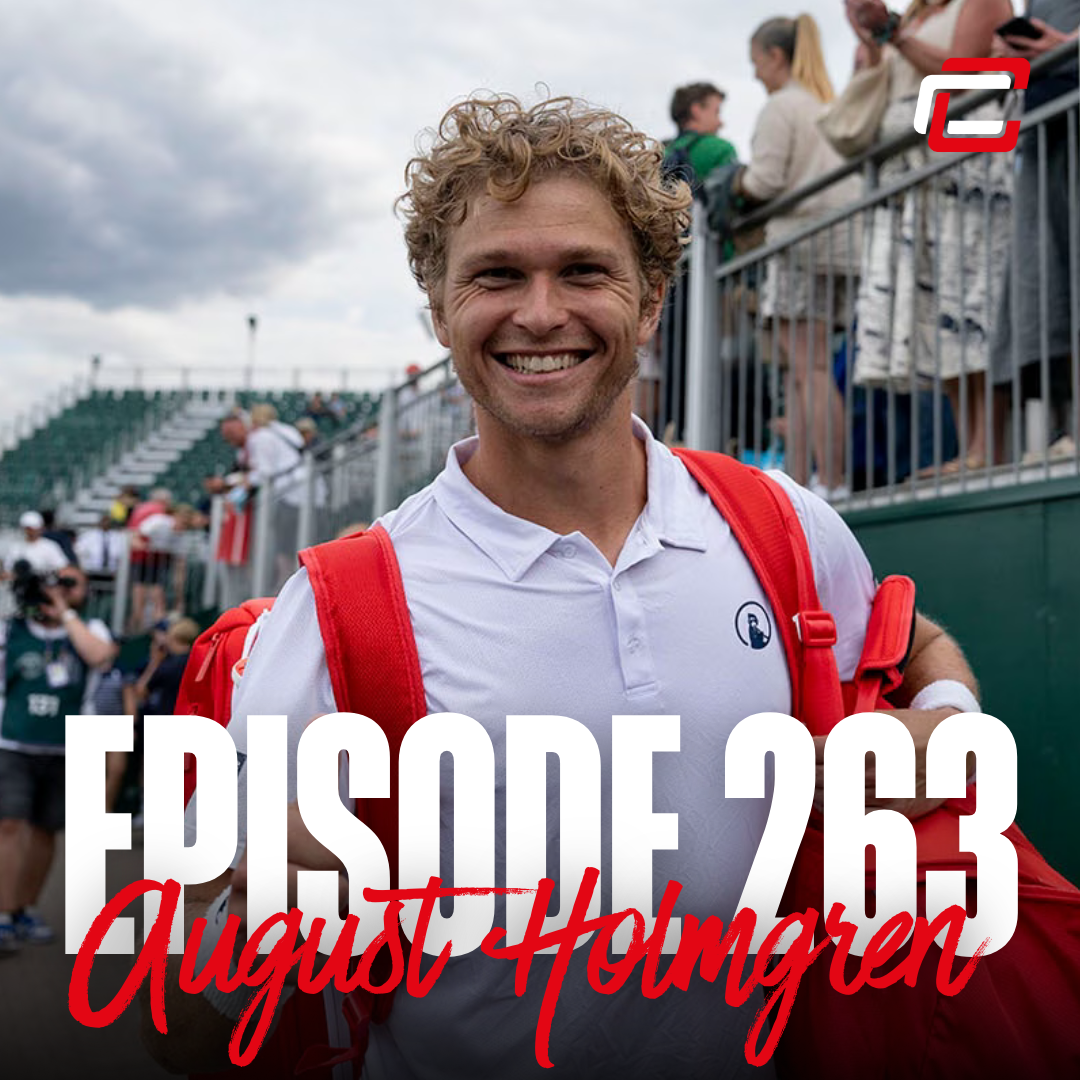
In today's episode, we have the Danish star August Holmgren. Straight after his incredible run at Wimbledon, reaching the 3rd round with 2 matches that lasted 5 sets across qualifying and main draw, before playing Alex De Minaur.
And directly following Wimbledon, he went on to win his next Challenger tournament in Granby. August attended the University of San Diego and advanced to the NCAA individual final, where he faced a certain Ben Shelton.
Reached a career high of 144 in the world and climbing every year. You guys will love his mindset on steady and consistent progress and blocking out the noise.
Talking points:
August’s incredible run at 2025 Wimbledon, making round 3 and playing Alex De Minaur.
The feeling of winning his 1st and most recent Challenger tour titles.
Growing up and playing tennis in Demark.
Battling through 2 matches that latest 5 sets at Wimbledon and winning them both.
Dealing with heat stroke and vomiting during a match.
Playing college and becoming the No. 1-ranked college player in the nation at the University of San Diego.
Playing Ben Shelton in the NCAA individual final.
How August fights and blocks out demons during his matches.
The main differences aspiring tennis players should know between the Future and Challenger tour.
Links mentioned in the episode -
Ep 108 Holger Rune: https://www.controlthecontrollables.co.uk/episode-108-holger-rune-no-doubt/
Ep 251 Adam Blicher: https://www.controlthecontrollables.co.uk/adam-blicher-getting-to-know-ourselves-rather-than-changing-ourselves/
Ep 254 Ethan Quinn: https://www.controlthecontrollables.co.uk/ethan-quinn-on-the-challenges-of-rising-up-the-atp-rankings/
Don't forget to head to our YouTube Channel and like and subscribe to watch clips and now full episodes of Control The Controllables: www.youtube.com/@ctc.podcast
Follow August Holmgren on Instagram here: https://www.instagram.com/augustholmgren/?hl=en
Thanks for listening!
Control The Controllables.

Episode 263: August Holmgren: Wimbledon Sensation and Challenger Champion
DISCLAIMER: Please note we use a transcription service, so there may be some errors in the following transcript for the episode. If you can, refer to the audio for the exact quotations.
Dan Kiernan (00:00)
Welcome to episode two hundred and sixty-three of Control the Controllables. And in today's episode, we have August Holmgren. August had an incredible run a few weeks ago at Wimbledon, where he came through the qualifying rounds and reached a third round, including two epic five-set matches, the second one against Macháč in the second round, before playing Alex de Minaur and losing in the third round.
And then a couple of weeks later, he went straight on to Granby, where he won the Challenger and showed that it was, it was time for August to start really making a move in the rankings. He's now at a career high of 144, and that has steadily progressed over the last few years.
He went to the University of San Diego, and anyone that follows college tennis will know that he made the NCAA Finals, where he lost in the final in three sets to a certain Ben Shelton.
You guys are gonna absolutely love this episode. You're gonna love his mindset. There's so much to take from it, and I'm excited to pass you over to August Holmgren.
So August Holmgren, a big, big welcome to Control the Controllables. How you doing?
August Holmgren (01:31)
Thank you very much, Dan. I'm happy to be here. I'm doing quite well. I'm sitting in my hotel room here in...
Dan Kiernan (01:38)
Better than you were on court at the end of the match last night. The heat stroke got you in Lexington. Tell us a little bit about that from last night, August.
August Holmgren (01:52)
Yeah, I mean, the heat took down another one. Old story, right? But I was feeling good up until when the match started. I was playing well in the beginning of the match. And then we had a long first set. I went through four t-shirts and had to change my shoes, because I was sweating through the shoes and the socks at 5-4 in the first set. So I was just sweating a bunch.
And towards the middle of the second set, I was starting to feel a little bit dizzy, and got a little bit of a headache, and it just progressively got worse. I really, for some reason, I really didn't want to retire.
You know, with my game style, maybe I can get away with staying in the match with a couple of good serves, and then I thought maybe I can have one game where I connect on a few returns. So we'll see what happens.
And then I just hit my limit at 5-1, 30-15, and had to run to the side to puke, and that was it. But it happens sometimes. But as I said, I'm doing well now. I just have to recover. Need a lot.
Dan Kiernan (03:03)
I would imagine that Denmark has not prepared you for those type of, that sort of heat over the last 20 years.
August Holmgren (03:11)
Yeah, not really. We do get warm temperatures in the summer in Denmark, but not with this kind of humidity over a longer period of time. Even when I was in San Diego, it didn't really get this humid either.
So I think the last time I tried something to this extent was when I was in Bali for my preseason with Jesper de Jong in.... It was tough there too.
Dan Kiernan (03:37)
Yeah. And it's almost like the thing that I find fascinating about this sport, you know, you're 27 years old, obviously still very young, but, but quite experienced now. You know, you've, you've had your junior career, you've had your college career, you've been on the tour for a little while now, and we're going to get into all those exciting things in a little bit.
But I guess you're still learning all the time, you know, and you now have a challenge, right? A challenge that, you know, maybe your body hasn't quite reacted in the way that you want it to react in extreme weather. So what will your process and protocol be now on how you find the right solutions to that?
August Holmgren (04:17)
Yeah, it's a good question, because it's happened to me three times this year now. I was playing in Nouméa in the first week of the year, where I ended up throwing up during the match as well. It happened two weeks ago, right after the match in the first round in Granby. Those times I didn't feel the dizziness and the headache. It was just in the stomach, and just ended up puking all of a sudden.
What was interesting is, yesterday after the match I had my blood sugar levels tested, and it was way, way, way too low. So I'm going to talk with my nutritionist and my physio and see if we can come up with a strategy to somehow find a way to get more carbs in me, or more electrolytes, or something, to adjust for these extreme heat conditions.
Because I sweat so much, I don't know what it will be, because there's a fine balance between drinking enough and drinking so much that I will get a stomach cramp, or my body can't absorb it, and then it's just going around in the stomach, not really helping anything.
Dan Kiernan (05:26)
Well, the rumour... look, when I have these amazing guests like yourself on this podcast, August, I make sure I have the right conversations beforehand, because I need to find things out about you. You know, one of the things I always say to the producer is, find me some things that you can't Google within 10 minutes. You know, I think sometimes it's too easy to Google things. And I think it's about understanding.
And one of my bits of research took me to the point that you can get quite hangry at times. You know, and that maybe food is something that is very much needed in your life, which for me links into this, right? It sounds like you've got a pretty quick metabolism. It sounds like you're someone who does lose calories, lose fluids pretty quickly.
You know, so that's someone, you know, like, we watch Carlos Alcaraz play, it looks like he never sweats. You know, like it's like everyone's got their different bodies, and, right, you know, everyone's got different bodies, got different ways that they react to different things. Do you think there's a link here between the hangriness and the dehydration?
August Holmgren (06:32)
Maybe, I can't tell you. I'm sure I get more frustrated when I'm hungry. You know, speaking on S&C, for my on-court strategy, I try to eat about 100 calories, or sorry, 100 grams of carbs per hour in fluid form, and then supplement with some gels. So usually I don't really feel hungry on the court. Yeah, I don't have a better answer to the hangriness part.
Dan Kiernan (07:10)
Okay. No, no, no, I just, I just think it's interesting. The big takeaway for me is that it's just constant learning, right? And it's like, and as we kind of jump into, there's so much I want to get into. Obviously I want to get into the old Wimbledon run, which was incredible. You know, and just Wimbledon this year was fantastic. There just was so many emotional runs that seemed to be happening with people.
You know, and I was glued, glued to the TV as you won that seven-six in the fifth set match. You know, I have to say there might've been a tear in my eye when I saw you hugging your dad at the end. That was a special moment, but we're going to, we're going to, we're going to get to that.
But I like to start and understand the context of people's lives a little bit as well. And again, looking into your, to your life, I know you ended up having a, a reasonable ITF junior ranking, but I also understand that you weren't necessarily the top of the top when you, when you first started playing.
The word, the word on the street is, you're someone who was a very hard worker from a young age, was able to kind of really set, set your own standards, which, which is brilliant. If I take you back to that one: when did you start playing tennis?
And the question I like to ask people is, how did this sport get into your blood? You know, because it gets into so many of our, our blood, and we can't get rid of it, and we don't want to get rid of it. But tell me a little bit about that journey.
August Holmgren (08:23)
Yeah, well, I started when I was four. It was my father who introduced me to tennis. We'd go out and play about once a month, I think. And then when I was six, I started in the local club in the city where I lived. And it was always really, really fun. And then I think I decided that I wanted to play professionally from when I was 10 years old.
Since then, I got introduced to a lot of really, really good coaches, who guided me along the right path of being process driven, which was always quite easy for me, because, as you said, I didn't really have any big results early in my career, so I didn't get used to winning a lot. So I had to find a different motivator.
But I always enjoyed the aspect of having something to improve upon. And I always thought that was really, really exciting about tennis, and tennis as, I'm sure, with all other aspects of a craft: you can always get better.
So, yeah, I started travelling with this group called Euro Elite Tennis when I was 11 years old. It was run by an American based in Sweden named David Bandel, a former college coach as well. And he was really tough in many ways, in terms of being professional in our approach towards the sport and towards the work. And that's where I kind of built my, or I got to learn my discipline, I guess.
And I really, really enjoyed it. And so it's always stuck to me, in everything I work at, and all the things I work... it came very natural to me to work hard.
And then when I turned 16, I used to say that that's when I kind of became, quote unquote, good within Danish tennis. That's when I won the junior championships in my age group. And I started to... I got my first junior ITF point when I was 15, in Kenya. I would travel all over the world with Euro Elite.
And yeah, it just slowly got better and better over time. That's always been my way of developing: just constant growth, little by little. And I guess that's also why I didn't break through, not to say I have broken through, not at all, but I haven't had that soaring breakthrough in the rankings.
Because it's always been a little bit here, a little bit down, a little bit up, a little bit down, slowly progressing that way. And that's been, yeah, that's, I guess that's been my modus operandi for my entire career.
Dan Kiernan (11:22)
Interesting. What's interesting for that with me is, I think there would be a lot more players that that happened to, if they allowed it to. But we live in this kind of instant gratification world. We live in this world that's very outcome focused. We live in this comparison world. We live in all these toxicities that kind of come in, right?
And that can either be fuelled from the environment you're training in, that can be fuelled from coaches you're working with, with other players you're around. But it can also be fuelled by parents as well. Not, not... Often parents don't mean to, you know. What was the influence from your parents on that?
Because it just, even speaking to you now, and I was lucky enough to briefly meet you at Wimbledon, you know, you've, you've, you've clearly got your head on your shoulders. You're someone I would look at as quite typically Danish, you know. Holger, who we've had on the podcast, I've always said is quite untypically Danish, you know, in many ways.
You know, like, but that kind of unassuming way, but just kind of bit by bit, you're doing your thing. How much do you think that was of influence from your parental and family upbringing?
August Holmgren (12:30)
I don't know. I'd say it's more influenced by my tennis coaches. One of my coaches, Jonas Vinson, I've been with since I was 10 years old, and we've always just been grinding away little by little.
I really appreciate my parents' approach to my tennis, because they've always been in the background. They've always just said, okay, we let your coaches decide what the best approach is, and then they've just been supportive.
Dan Kiernan (12:58)
Which is kind of my point, August. That's my point I think I was trying to get to. That's the influence I'm talking about, the influence of giving space. You know, like, because I think in order to have that outlook that you've got, and that kind of small gains, moving up, moving down a bit, moving up, and kind of making that way through without too much panic...
I do think you have to come from, or have, parental influence that allows for that space to happen, rather than some that would be there: we're paying for this, we're paying for this, this needs to happen, you know.
August Holmgren (13:31)
Well, in that case, yeah. Yeah, well, in that case, that makes a lot of sense. My parents have always just said, do it if it makes you happy, and if it doesn't, there's no love lost at all. So they never applied that kind of pressure.
Dan Kiernan (13:51)
That's it. It's fun. So that moves me into something I'd love to ask you as well. When I first set up the SotoTennis Academy out here in Spain 15 years ago, I did, like, I guess, a promotional video. And on that promotional video, I said, players make players, coaches don't make players. You know, that was something I felt quite strongly about.
Now that I've coached and been lucky enough to be around a high level of tennis for the last 15 years, but more specifically the last five or six, I don't know if I fully believe that. I think I still believe that to a degree, but I think I understand more and more the influence of coaches.
And I guess the one that I've worked closely with, Louis Cayer, he's now been involved in just so many, so many British Wimbledon or Grand Slam champions. It's, it's, and before that nobody ever won them. So what's, what's your take on that? How, how influential are coaches, and, and if so, what are the biggest influences coaches can have, certainly in those kinds of earlier years?
August Holmgren (14:56)
I think that the coaches have a tremendous influence, not because they're coaches, or not only because they're coaches, but because they're people that you spend a lot of time around. And in the same way, I wouldn't disagree with your claim that players make players either, because I think it's a common social experiment, right? You kind of adopt the mannerisms and tendencies of the people that you surround yourself with.
An easy example that I can think of here is the difference between being at a Futures tournament and being at a Challenger tournament. One of the first differences that I noticed when I made that change is that in Challenger tournaments, you don't really see anyone not warming up, not doing a cool-down, not using the physios. They're all very, very professional in their approach to the matches.
Whereas in Futures tournaments, you can come across a lot of people that are great tennis players, but don't have as professional of an approach. I think it's something that's also common in tennis clubs, some tennis clubs in Denmark, and I guess everywhere, right?
If you have those role models that you can see, that guy is good, and he's doing, or she's doing, this and that, it makes it so much easier for oneself to also do those things. Whereas if you see your friend or your practice buddy, okay, he just shows up five minutes before practice starts, then it makes it more okay for me to do the same.
Whereas if everyone shows up 30 minutes early and then you show up 10 minutes early, then they're like, okay, where, buddy, where were you? Right? It adds that kind of social pressure, peer pressure, to do the right things, which is a very good use of peer pressure, I think, in relation to the usual negative connotations that it has.
So I think that, for me, that's more what I would say is my takeaway from that: players make players, or coaches make players. I think people make people.
Dan Kiernan (17:12)
Yeah, very good. That's a nice little summary on it. In terms of the bit you're saying, so if I take you... I've still got you as young, I'm still keeping you as a junior right now. You haven't reached 16, you haven't become, you're not winning yet.
Were you at that age... I get the impression maybe you were a little bit of a black sheep at that age, of kind of doing things maybe a bit more professionally than others. Would that be, would I be right in thinking that?
August Holmgren (17:42)
I think so, yeah. I don't know if I was always doing the right things, but I was always trying to do as much as I could with my knowledge to be better.
Dan Kiernan (17:54)
Yeah. So how did you avoid the negative connotation of peer pressure? You know, because I always, I've always said this, and I think the British tennis culture does this better now. But when I was younger, the black sheep was the one that was doing it right. And when I set up the academy in Spain, one of the first things I wrote down is, I want the black sheep to be the one that's doing it wrong.
Because, you know, that for me, that's a big cultural difference. Because I think when the black sheep is the one that's doing it correct, that can be quite a lonely, difficult place. How were you able to not give in to the peer pressure that was around you, of maybe not doing the right things?
August Holmgren (18:36)
It was never an issue for me. It's never been difficult for me to say no to the things I didn't want to do. I don't know why. Maybe it has to do with my upbringing, or with the people around, but yeah, to do my stuff, and, when I was in college, to not go out in the evenings and not drink and all that stuff, was never difficult at all.
Dan Kiernan (19:01)
Okay. What a skill that is. And I think the fact that you find that like a normal skill, I think that's such a massive quality that you've got, that's clearly played into the successes that you've had, really, as well, and will continue to have.
Because I think so many of us in life can live our lives constantly worried about what other people think, and we're so influenced, even more so now, right, in the social media world that's out there. There's so many different distractions, and I see it, I've got three kids, I see it with my kids. All of a sudden they're doing something, or they're saying something, or they're acting in a certain way, and it's like, hold on a minute, that's not you.
That's like, can you... so, again, I wanna move it into something else along those lines, because I'm kind of fascinated by this. This is a brilliant topic. Performing arts was a part of your world, a big part of your world, which I'd love you to tell me a bit more about. Do you think it was linked to that in any way?
August Holmgren (20:07)
Maybe. But that came before the performing arts. I went to college thinking I was going to be a philosophy major, and then after a year I decided that that wasn't for me. Then I spent the next year kind of deciding what I thought should be my major. I went back and forth between a few different subjects, and in the US you have two years to declare a major.
At that point, I said, okay, I'm taking a theatre class every semester. It's been my favourite class every semester, so I might as well study what I enjoy. It just made a lot of sense to me. From a peer pressure standpoint, it's a very uncommon major or education, and it also took my parents about two weeks to get on board with it too. But yeah.
Dan Kiernan
Okay. But before college, had you done that quite a bit as well? Had you been in that world before college?
August Holmgren (21:00)
No, not at all. Not at all. I come from a family where we're very expressive. Like, we have a lot of... like, when we meet, we try and meet up once or twice per year, and then we do a lot of, like, singing together, as a family tradition.
And when we were really young, we put on, like, plays, small plays, in our... my grandparents had a summer house, and then the whole, on my mother's side, her whole side of the family would come. And then when we were like seven, eight years old, we were ranging from 15 to, like, five years old, and then we all had different roles.
But I hadn't done anything of the sort my whole life, except for, like, the odd school play in second or third grade or something, like Oliver Twist and that stuff. So, no, it came as a surprise to me to do that stuff.
Dan Kiernan (22:07)
Right, okay. Okay. And what did that entail, doing your major in that?
August Holmgren (22:10)
Yeah, well, the theatre major as a bachelor entails an introduction to the many different branches of theatre. You know, there's the things that you think about when you think of theatre. You've got the acting, the directing, the scenic design, costume design.
But it's also critical analysis of scripts, writing, it's learning history, it's production, managing, you know, taking care of the money side of it, and obviously public speaking. So it's a different introduction to the many different aspects of the theatre world. And then if you do a master's degree, that's when you kind of hone in on that one particular aspect.
And what I thought was really cool about the theatre education is that you often had to bring your own analysis on the different subjects and figure out things for yourself. And in the acting classes and such, you had to be really... sometimes vulnerable, not so often vulnerable, but more so put yourself out there in uncomfortable situations, and talking in front of the class.
But it was in such a safe environment, that everyone was doing it, and that made it really cool. So that was one of the things that really was appealing to me with the theatre major.
Dan Kiernan (23:26)
In terms of picking to go to college, you know, you were 83 in the world in juniors at that point. You know, you were obviously one of the best players, if not the best player, in Denmark. Was making the decision to go out to college to play a difficult decision? Was that always part of the, part of the plan? And then how did you then pick University of San Diego? What was that process as well?
August Holmgren (23:50)
Yeah, no, it was a super easy decision. I still think if you're winning, at least winning Futures, by the time you're 18, then there's no reason not to go to college, even more so now than ever, with the NIL deals that you can get if you're good enough. So it wasn't a question at all. I had no chance of having any kind of impact with my level when I was 18. So I knew I was going to go to college.
Then, in the process, I had this spreadsheet with different questions, and I spoke to all the schools that reached out to me. I think there were about 30 schools that I was on Skype meetings with, and I ended up narrowing it down to first five schools, and then two schools, San Diego and Rice University.
And I went to visit them. I really, really liked San Diego. I felt at home. I really liked the way... I liked the coaches at both those schools. And I just felt much more at home in San Diego. So that's how that decision came about.
Dan Kiernan (24:57)
Yep. In terms of college tennis, for people that don't know about college tennis, how good is it? I'm lucky, I went to LSU, so I know. But somebody listening right now that's thinking, should I go to college? What should I do? Tell us about that experience.
August Holmgren (25:15)
Yeah, if you're at the right place, it's an amazing experience. If you're at the wrong place, it can be a pretty tough experience. So you have to find a good place. I was very lucky that I ended up with amazing coaches and teammates.
For a lot of, I mean, and the level, you can see, with all these guys breaking through that were at the top of college tennis, or making big waves in the world of tennis right now. Shelton being the best example, right?
You've also got Walton in the top 100, Fearnley. Even before that, you had Norrie, who played, I think he played three years, two or three years, at TCU. Anderson, all those guys. So the level in college is really, really high. So that's not an argument for why you shouldn't go to college, that you can't find good enough sparring.
Especially if you compare the set-up at colleges in the US to the set-up that you can have in Denmark. It's so much better, unless you just have a lot of resources or a lucky set-up in Denmark. Because in the US you have the coaches, teammates, physios, fitness trainers, psychologists, nutritionists, all in one place. So it's really hard to beat. Plus you have the social aspects that you don't really get as easily when you play professional.
Dan Kiernan (26:47)
If you didn't go to college, do you think you'd still be playing?
August Holmgren (26:50)
Yeah, I think so. I think so.
Dan Kiernan (26:53)
Because that's five years, right? You were there for five years, I believe. Looking through, it's really interesting, because it's that, like, just getting better, getting a bit better each year. You know, what number did you play at San Diego in year one?
August Holmgren (27:08)
I switched between playing one and three. I started pretty strong. I started as number two for the majority of the first year. Played one a few times.
Dan Kiernan (27:18)
So you started pretty strong, okay. Right, okay. Okay. Made NCAAs year one, didn't make NCAAs year two, is that right? I don't know if my information's correct here.
August Holmgren (27:25)
I made it, not in singles, but I made it in doubles.
Dan Kiernan (27:28)
Okay, so in singles, and then in your fifth year, made the final of the singles, and lost to a certain Ben Shelton…
in three sets. And at that point, because Ben had a very interesting college career as well, right? He, obviously his dad was his coach. He did start a bit lower in the line-up at University of Florida, and then he seemed to grow, seemed to develop this serve. And, you know, how good was he when you were playing him at that point?
August Holmgren (27:56)
At that point, his serve was already unbelievable. His kick serve was bouncing over my head. I had to return it up here. And he could mask his serve so well. So I had no idea if it was a slice or if it was a kick. And he's so big, and yet he's an unbelievable athlete.
So, especially in the NCAA... we played twice. He beat me both times. And in the NCAA tournament, I came out quite well, but throughout the match he just got better and better and better. And by the end, I had no idea what to do. He just, every time I made him run to the forehand, he would slap a forehand winner down the line. It's like, okay, too good. What do I do?
Dan Kiernan (28:36)
So he was ready. He was ready to go, wasn't he, when he left college? Which obviously showed. The question that comes into my head when I speak to someone like you, August: at what stage did you decide you wanted to be a professional tennis player? And then I've got a follow-up question to that. Do you remember what age you...
August Holmgren (28:57)
Yeah, he was ready. When I was 10 years old.
Dan Kiernan( 29:00)
So when you were 10, so you knew that early. At what age did you believe that you could be?
August Holmgren (29:06)
I think then as well.
Dan Kiernan (29:07)
And has that faltered throughout? Has there been any times where you've thought it's not possible throughout that period?
August Holmgren (29:14)
It never faltered on a base belief. But many, many times after match losses I've had the demons, you know, the demons we all have in the head. They say, why are you doing this? You're shit. You're losing first round of qualifying in a 15K Futures, meanwhile Tsitsipas and Shapovalov are beating the top 10 players in the world. So yeah, there's been rough patches every now and then, but my base belief has never really faltered.
Dan Kiernan (29:54)
I love it. I love that. That's for me what belief is, right? Like, we talk about confidence and belief. Belief for me is that, is that base thing that you're talking about, that it's inside, you know. Confidence is, it can ebb and flow depending on our recent past experiences, you know, and it seems like that's held strong.
What's the lowest point of your career when you look back? Was there a point where things got really low, or you seem like someone that can quite stay quite even?
August Holmgren (30:25)
I think two years ago I was struggling a lot. I was on a five-match losing streak. I've never really had a very successful spring season in my three years as a professional player. I'm a summer guy, exactly. Summer and fall guy.
Dan Kiernan (30:42)
You're the summer guy. You're the summer guy. We're going to get to that. We're going to get to that.
August Holmgren (30:53)
And so that first year after graduating, that was really hard. It was just because I was losing, and I was also looking like a loser as I was losing, and feeling like a loser, just feeling so sorry for myself. Which is... yeah, so it wasn't a good spot.
And it was my coaches that got me through that one. I was with Freddie Nielsen at the time, and we went to a tournament in Nottingham. He took me aside and said... okay, I just lost, I was playing two tournaments in Nottingham, I just lost the first week. And then he was like, okay, now we're going to do a deal.
You have these, I think there were six things we were working on, and you're only going to think of those things every time you step onto the court. It had to do with... I had to take as many steps as possible whenever I was playing.
So I would be gassed after two minutes of hitting through the middle, because I was just absolutely trying to work, like my feet were drumsticks, in between every shot.
Dan Kiernan (31:50)
That's unfair, for Freddie to ask you to do something he didn't used to do.
August Holmgren (31:55)
Well, Freddie had a different kind of game. Yeah, and then I had to walk really fast in between the points. I had to always look up. I could never walk and look down. I had to get my backhand to go through the baseline as quickly as possible. And I forget the last two things, but just, like, really basic things like those.
And that became everything I was obsessed with, and then I ended up winning the next tournament, which was a big help and got me out of that slump right away. But it was so funny that as soon as the focus became different, or got away from whether or not I won or lost, then it became so much easier to deal with setbacks in the matches.
Dan Kiernan (32:42)
The comment comes into my head: Do coaches make players, or do players make coaches? I'm sorry, do coaches make players, or do players make players, again? And I'll tell you why, because that's great coaching by Freddie. And Freddie, I hold him... he's a very good friend of mine, but I hold him in very, very high regard.
You know, Freddie's someone who's massively influenced my philosophy over the years. You know, any opportunity we get, we talk tennis, and I think he's got one of the best tennis brains out there. I just love, I love his way he thinks and his philosophies.
So that's great coaching by him. However, that's also great playing by you, in terms of being able to take that on and then commit to it. You know, because so many... I guess as coaches, one of the things we can do, we can, we can take the horse to the water, but we can't make the horse drink the water. You know, it's that, that whole concept.
And you, you being the player, going, okay, I'm going to buy into that, and no matter what, that's what I'm going to do. And obviously you got your reward quite quickly from that, you know. But that also says a lot about you as a player, to be able to do that.
Because I honestly think a lot of players get that information, but actually don't actually put it into action, you know, and that's then where your bigger challenges come as coaches as well.
August Holmgren (33:59)
Yeah, it was also easy to do, because everything else I was trying to do clearly wasn't working. So I was very open to trying new things. And that's actually one of the things that we are focusing on a great deal right now: to stick with what's working when I'm winning as well.
Because in my pro career so far, I've had all of my best results coming off of really tough times. You know, this year I was six and 14 before Wimbledon, and then all of a sudden I have a good run at Wimbledon, I win Granby. And I want to make sure to stay with the things that are working.
One of the things I did last year, after I won Porto and got into the top 200, was I got lulled into that trap of thinking, oh shit, I'm top 200 in the world, now I have to play like a top 200 player. And then I put a totally different kind of expectation on my tennis, and it was really, really hurtful. I hurt my game a lot.
Because all of a sudden I didn't have that acceptance of easy mistakes anymore, because I thought, but I'm supposed to be better than this, so I can't miss a second serve return that's hit at 100 kilometres an hour. How in the world could this happen? Whereas when I was winning tournaments, I would miss them all day and I didn't give it a second thought. So that's the challenge that I've had.
Dan Kiernan (35:23)
Yeah. And people will learn, I hope they will, they will learn so much from that last two minutes of you speaking on that. You know, because it's, what you've done is you've given us layers. You've given us layers to process over outcome.
You know, I think it's one of the, it's one of the most cliché things people say, is it's process over outcome, process over outcome. But you've given us some layers to that thought process, you know, and, and, and understanding that.
That the protocols that you put in place, and that you commit to, I call them committed helpful intentions, you know. And it's then, but there's many different distractions. There's not just the distraction of losing and playing badly. There's the distraction of complacency, there's the distraction of expectancy. There's many little things that will try and pull our minds into various different places.
And before you know it, what we're doing is we're not actually committing to these little small things that add up into performing well. And I think you've described that really well. Now, I asked your lowest point. It's only fair that I also give you the chance to talk about your highest point to date. What would you say your highest point to date has been in your career?
August Holmgren (36:40)
It's tough to argue with the Wimbledon run. I guess I was more feeling more ecstatic after I won my first Challenger tournament, in Pozoblanco in Spain last year.
Dan Kiernan (36:54)
That's near me. That's only two, that's about two hours from us. Hot. That would have been hot at this time of year. Yeah.
August Holmgren (37:00)
Yeah, it's really hot. But we played in the evenings, and it was dry. It wasn't so difficult.
Dan Kiernan (37:06)
Yeah. Yeah, it's dry. Yeah. I love that tournament. I don't know if you know the history of that tournament, but that tournament's been there for, like, 80 years. And, and they... it's always what they do in Spain, is they, they host these events. There's a couple of great Futures as well, that they used to be, like, community tournaments that were money tournaments.
And then, depending on where they're at, can be cut. There's sometimes ITFs. So Pozoblanco was an ITF Futures for quite a while. It was then a Challenger. It then became just a money tournament, and it's kind of evolved.
But there's always been that... I'm sure it was there. They had all the kind of activities for the kids and bouncy castles, and quite a lot of the town go to the tennis, and it's like a bit of a celebration of kind of sport in the area. So it's actually quite a famous tournament in Andalusia, our region in Spain. But it's a fantastic tournament. Tell us about that feeling. What is that feeling when you've won that title?
August Holmgren (38:07)
It was just so much happiness. However, what I wanted to say with that as well is that I'm not sure it's necessarily a good thing. It was almost too much. You know, like when you get too high, or you get too low, you can also get too high.
Whereas two weeks later, when I won Porto, I felt way less excitement, but much more satisfaction. It was like, yeah, okay, I can do this. I felt really cool. It wasn't like, yeah! Like a crazy football fan. It was more like a really good day in the office, where I did my work. I'm really satisfied with my work. And it's just such an interesting comparison between the different feelings of happiness, I guess.
Actually, I forgot. Maybe the time I got most excited was when I won my full championship tournament at college in 2021. Because afterwards, it was in San Diego, and I celebrated it with all the guys there. And I think that was the time when I, the only time when I almost got drunk. I think it was such a good day and evening.
Dan Kiernan (39:16)
You got the team, and yeah. You're showing off now, August. You've had all, you're showing off with all of these high moments now. You've had a privileged career to be able to talk about all of these different, you know, already.
August Holmgren (39:28)
Yeah. Very privileged career.
Dan Kiernan (39:23)
Now, they are amazing, but I do have to take you to Wimbledon. You know, and like you say, going into Wimbledon six and 14 on the year, turning up into qualifying. In the first round of qualifying, playing against a British guy who's tricky. He's tricky on the grass, you know, and you come away from being a set down and win seven-five in the third.
Second round, and you're also a set down, and you come back, and you win a tiebreak in the second set. And then last round of qualies... I remember Freddie talking to me about this, but you're gonna have to tell us about this last round qualifying match, because it all happened.
You know, the full score: six-four, six-seven, three-six, seven-six, 13-11 in the tiebreak, and then 10-7 in the final set tiebreak, seven-six. Tell us a little bit about that match.
August Holmgren (40:30)
Yeah, it was a really cool match too, against Watanuki. Yeah, we're both kind of trying to accomplish the same things, with being aggressive off the serves and returns and controlling the points with our forehands. Watanuki is obviously a really, really well established and high level player. Super quick, and there's very few places where I could really find a specific weakness in his game.
So a lot of it had to do with just who could play the highest quality of tennis. And I started out really well. I think I just had one break, but I was holding serves simply, or I don't want to say easily, but I was hitting my spots pretty well. My serve plus one was working. I think I was up a break in the second set as well.
And slowly he starts to tear his way back, some big returns, and kind of controlling the baseline rallies much more than he had in the first set. So then I lose the next two sets.
I don't think there was any breaks in the fourth set, but I had no business in his service games at all. He was just hitting his targets really well, and I think I was missing a bunch of returns as well, not even hitting with high quality when I got it in.
And then we get to the tiebreak, and I forget, I think he had four match points or five match points or something in the tiebreak.
Dan Kiernan (42:04)
Wasn't there some crazy dive you did, or...
August Holmgren (42:06)
No, there wasn't. There was a dive. I had two dives. I did one on a break point in the second set, which was almost a pathetic attempt to get it back. I had no chance. And then I dived again after an approach, and he missed it in the net. The Danish media called it heroic.
And it was just, it was so ridiculous in reality, because he missed the ball in the bottom of the net, and I did, like, a full faceplant dive, which was so unnecessary.
But there was... his first match point, I hit the most, one of the best returns I've ever had. Freddie calls it a Matrix return, where he did a massive body serve. I'm going to see if I can adjust my camera. And I did, like, one of the, the knee away, just leans back to avoid the bullet. Did this with my racket.
And I smacked it so hard right back in the middle, and then we played an unbelievable point, where we were both just hitting the shit out of the ball, like five, six shots. I somehow ended up winning the point. I think he missed it deep. And I don't know if he had any more match points on his own serve.
But yeah, then I ended up winning it, winning the match, the tiebreak, with a double fault from him. But yeah, it was a crazy level. Crazy level.
Dan Kiernan (43:28)
And the thing about that, we actually were speaking about it at Wimbledon, because it's... I was saying, and then I ended up with egg on my face because it happened quite a few times in the main draw. I said, I think the most emotional day in tennis is the last round of qualies at the majors. And it feels like it's highly emotional on both sides, right?
You know, it's like, and especially at Wimbledon, because you get a chance of moving. You're moving, there's like a physical thing as well. You're moving from the Bank of England courts at Roehampton to the big dance. You know, it's like, you're not even, you haven't even made it onto the site at Wimbledon, you know, before...
August Holmgren (44:10)
I think it's also the only qualifying final that has best of five sets at the slams, right?
Dan Kiernan (44:15)
I think it is, I think it is. So the drama is big. It's like, obviously the finance, it's players that haven't tended to play too many Grand Slam main draws. And I was saying, it almost feels like it's the only time you see people crying tears of happiness.
You know, in our sport, you can often see people crying tears of sadness, but I love the emotion that comes out, you know, the tears of happiness emotion. I think there's a one that just, that's what I love about sport and live sport, and what I love about tennis. I just love the emotion, the passion. I love the storylines behind it.
I love, you know, that what someone's done from the age of four, you know, all coming out in that moment. And then I said that, and then at Wimbledon, we had about seven different matches where people were crying tears of happiness in the main draw. You know, Cobolli, we had all these different things. It felt like quite an emotional one.
I wasn't there, I didn't actually see the moment when you qualified, but talk us through that. Were there tears of happiness? How big was that emotion at the end of that qualifying match? And how does that compare to the emotion at the end of the second round match against Macháč?
August Holmgren (45:28)
Good question. I don't know. I think it was the same, because I was there with my family. My dad and my nephew were there for the qualifying final as well. And obviously it was the first time I qualified for a slam, in the five-set match, tiebreak in the fifth set. Hugely emotional there.
And I guess it was the same, just even more, against Macháč. Many more of my family members came out, and the stadium was filled with Danish fans. Yeah, I guess even bigger against Macháč, because it was a big win.
I honestly have a little bit of a hard time remembering everything that happened. So I kind of just, I see the videos and I was like, whoa, did that happen? Did I really, did I do that? And did I really cry that much? I can only say it was an unbelievable experience in both of those matches.
Dan Kiernan (46:29)
Very cool. And then you said something earlier, August, which I always think is quite an interesting one. And I think it's quite well known in the tennis world that there's a big difference between Futures and Challengers. I think it's probably the, it's the least subtle difference, let's say. It's the kind of biggest difference that people tend to see in professionalism.
There's then the difference between, I guess, Challengers and, not so much Grand Slams, because a lot of Challenger players are playing Grand Slams, but Challengers and ATP events. But then you have the difference between that and playing top 10 players, you know.
And you then went on to play Alex de Minaur. He's a top 10 player in almost every category, you know, de Minaur is. What did you notice the difference was, if any, coming up against de Minaur?
August Holmgren (47:21)
I would say what I've noticed, from practising with Holger as well and seeing a bunch of his matches, and playing against de Minaur and Macháč, in a lot of the same ways, is that they can maintain an extremely high level throughout the entire matches.
And I think that's what the biggest difference is between Challenger players and ATP players: they can just maintain a really, really, really high level throughout an entire match, many, many, many weeks of the year. And Alex de Minaur did that better than any other guy I've played against.
He's got his qualities of defensive tennis, and then being able to counter so quickly as soon as I leave a ball short. So he was probably the fastest player I've ever played against. But that wasn't what was most impressive about him.
I thought the most impressive thing was the quality with which he got the balls back when I was trying to hit a big forehand. He would hit it back so flat and deep that I was neutralised immediately.
And he got way more returns back, with higher quality, than any of the other guys that I've played against. He gave me next to no free points in his own service games.
He's just... him, Holger, Tomas, are doing the basics so much better than all the other guys. And that's what's the most impressive and the most difficult, I think, looking past all the highlight points that you see sometimes.
Take Alex de Minaur, for example, when he's just running from the back of the court to catch a drop shot and lean it into an unbelievable pass. Yeah, sure, that's amazing, an amazing feat of physical strength and quickness, but that's not what makes him a top 10 player in the world.
It's that focus to play at that high level all the time that just strangles his opponents at the end. That's what's really impressive, in my opinion.
Dan Kiernan (49:42)
He, I think he would be, potentially would be in my top three worst nightmares to play, if I, when I, when I think about the male players. You know, like, I think maybe Alcaraz will give you a little bit, you know, lose focus, but it feels to me de Minaur is that guy.
And we've had a couple of people on the podcast recently. I think Taro Daniel, and maybe Tristan Boyer as well. They both, they both picked out when they played de Minaur how difficult he was to play. You know, like, he's the ultimate professional.
Now, I'm conscious of your time, and I want to just ask you a couple more things, and we've got to do our quick fire round before you go, which is the tradition of Control the Controllables. But you then went on after Wimbledon, almost more impressively, to then win a Challenger.
Tell us a little bit about that period, you know, from a relatively small tennis country. I know Holger is obviously leading the way on that. You've had Caroline for many years. I remember when Freddie won Wimbledon in 2012, you know, they all went crazy. You know, I would imagine that there was a bit of a difference in your world all of a sudden after that Wimbledon run.
So talk us through that period, of how you handled that, enjoyed that, but then also how you reset to be able to move over to the hard courts and then win the Challenger in Granby last week, which is highly impressive, to be able to back that up as well.
August Holmgren (51:09)
Tennis in Denmark has received a lot more attention. We have Clara Tauson as well, who has her career-high ranking right now in the top 20. So I think tennis has become way more popular in recent years, with Holger's and Clara's success.
I received so much attention and sweet messages. The days following were a little bit overwhelming in many ways as well. So I was almost happy to just get back into the groove of playing tournaments. I was very conscious of that, I wanted to keep doing the same things that had given me success at Wimbledon, keep doing those things in Granby regardless of the results.
And I almost lost the first round, against James Watt. But you know, I stuck to my guns. I ended up winning it. Ended up winning the tournament. And I was really pleased with what you said as well, continuing the run after success, in a smaller tournament.
I keep trying to remind myself that it's not about the results, it's about that continuous progress, because I still have a long way to go in many different aspects of my game.
Then last week I lost the second round, against Mark Lajal. I had a lot of things I could have done better in that match. But again, I'm really happy that I tried to stick with my tennis identity, with what's been working for me. It didn't work in that match, and then I have to accept that outcome as well.
My game is really risky in many ways. I try and be really aggressive. So some days I'm just going to miss more. Some days I'm going to play amazing, and it looks amazing. Other days I'm going to look a little bit silly.
But it's that being okay with that side of it too that's going to be so important for me moving forward, especially because that's what, historically, I haven't been great at up until now. And that's kind of the narrative I'm trying to change for myself.
Dan Kiernan (53:18)
What does the rest of 2025 look like for you? Are you a goal setter? What can you expect, or what are we going to see from you for the rest of 2025?
August Holmgren (53:30)
I'm gonna be playing in Chicago, then US Open qualies. We've got Davis Cup, depending on how the US Open goes. I will play a tournament on clay before Davis Cup. After Davis Cup, I haven't made any tournament plans yet. I was thinking of maybe going to Asia. I'm gonna be losing a lot of points this week. So we'll see where my ranking is at after Davis Cup. I don't know. I don't know.
Actually, just today I was invited to go on a surf camp for a week with some of my old San Diego friends. So I might do that in October. Pretty excited about that. But I don't have any big plans for the rest of the year.
In terms of goals, I have some things I've been talking with my team about that I'm not going to share right now. But it doesn't really have to do with the ranking. Usually ranking goals haven't helped me so much. It's put more pressure on me, that I haven't been able to handle very well, rather than being a motivating factor.
Because the purpose of having a goal is to wake up and be like, okay, yeah, I'm going to go for this goal today. That's not really a problem for me. So the top 100, for the sake of chasing the top 100, isn't something that's hugely exciting to me.
Dan Kiernan (54:51)
Can I ask you something on that? I don't want to be responsible for... well, I've actually spoken to you now for an hour, I know that I can't touch your mind on this stuff anyway, so I feel fine asking you this. You know, there is that kind of talk of the elusive top hundred, that kind of Holy Grail in our sport. It's kind of a bit of a, it's maybe a little bit outdated, I think, but it's a bit funny.
But I think the one that actually is interesting for me is, at 27 years old, you know, you being someone who is getting closer to that sort of ranking... in my day, that was almost deemed as impossible. You know, like it was almost, and, you know, I'm kind of 18 years older than you, but it was like, no, no, no, you can't. If you haven't broken top 100 by the time you're 21 or 22, forget about it.
You know, whereas one thing I do like about how our sport has evolved and normalised is that there are these stories. And this is why I really, if I'm honest, it's why I really wanted to get you on this show as well.
Because I think your story, and it's exceeded my expectations even more so in terms of how you've talked about it, but I think it's such an important message for people to understand in our sport.
You know, like, you chip away, you keep going. You have your ups, your downs, but you keep progressing. You keep sticking to the process. You get good people around you, you know, and you, and look where it could potentially take you with time.
Is that something that you are comfortable with, you know, within our sport? And is that something that, I guess, yeah... but really, what's your take on that elusive top 100, and maybe the age associated to that?
August Holmgren (56:31)
Yeah, it's the same question that a lot of the Danish reporters asked me after Wimbledon. They say, you're 27 years old, you're very old, why are you breaking through now? Or why are you having success now?
Yeah, I don't have a good answer for this, man. I think everyone progresses at a different rate. So for me, getting better later is just my path. I don't think it can be made a general notion of the right way to do things. So I don't have a good answer.
All I can say from my perspective is that I believe in my own abilities. I believe in my chances of becoming an even better tennis player than I am today. And then by the end of my career, when that happens, hopefully a long way down the road, I can afterwards evaluate and see if I'm satisfied with it.
Dan Kiernan (57:25)
I would have a slightly different spin on that as well, in terms of when people look at it. For me, if I was speaking to the Danish press, or if I got asked this question about you: you did five years of college. You've actually only been playing on the tour for about three or four years. You know, it's like, it's a very, like... I'll share a quick story with me.
I went to college, I came out of college, and so I would have been 22 when I came out. And I, I then, when I'd just turned 23, I won my first Futures singles, and I won my first few Challenger doubles. So I was top 200 in doubles, and I was maybe six, 700 in singles.
And the head of the federation at that time said, Dan, you're 23 years old. You're only six, 700 in the world. It's, it's passed for you. It's gone. You know, I think you should focus on doubles.
And at that time, I guess you take those words a little bit, you know, I, you know, maybe didn't have much direction at that time. But it was like, when I look back, when I look back at that, I was, that was like seven months, eight months after I'd come out of college, you know. So people were putting an age on it without seeing the context.
You know, and I think we do that in our sport a lot, actually. You know, when we look at your story, you're still just getting started, for me. When I hear your story, I'm like, well, yeah, you're just at very early stages of your career, coming out of college and going along that way.
And that's the bit that I want people to understand in our sport, anybody that's listening. It's like, you know, stop putting ages on things.
And the second point I just want to make, August, and this is my big, big takeaway from this conversation, is your outlook on it. And your outlook from a very early age has allowed you to go this kind of slower way, you know, and this kind of constant progression.
And I think not enough people have the right outlook on it, and they don't have the patience, and they're looking for the quick fix. They're looking to change coaches all the time. They're looking to do this. They're getting stressed.
And ultimately that's what kills them, because the losing kills them and they can't handle it, and then they have very short careers and they're unable to constantly put that daily work in.
So albeit that's normal for you, I don't think that is normal in our world, and I think it's a highly impressive trait. I think it's something that's gonna just continue driving you forward over the next few years, and I wish you the very best of luck with it.
August Holmgren (1:00:04)
I like your spin on the answer to the first question. I'm sorry about your experience with the guy from the federation. He sounds like a real asshole.
Dan Kiernan (1:00:13)
Yeah, but that's how we've evolved. I think that's how the sport evolved. I wouldn't be the only one, right? That would be kind of how it was viewed. But you've been a star. Do you have two or three minutes for the quick fire round?
August Holmgren( 1:00:23)
Yes.
Dan Kiernan( 1:00:25)
What does Control the Controllables mean to you?
August Holmgren (1:00:29)
It means taking care of all the things that I can take care of. That's such a bad answer. It means accept, and prepare really well. So prepare your strings, grips, all the equipment, sleep. Don't worry about the weather, the level of the opponent, the fans. Only worry about the things that are within your control.
Dan Kiernan (1:00:56)
A bit of an apt question: what's your favourite in-match snack?
August Holmgren (1:01:01)
Match snack, what's that?
Dan Kiernan (1:01:04)
A snack that you would have when you're in a match.
August Holmgren (1:01:06)
Oh, what's my favourite in-match snack? I understand. It's gotta be the electrolyte gummies. Amazing. Amazing. Yeah, I'll tell you what I hate too. I hate bananas. Bananas are the worst thing. I eat them a lot, but I hate them so much.
Dan Kiernan (1:01:16)
Oh, do they have them now? Okay. My daughter is with you. She claims that she's allergic to bananas. She's not, but she can't bear them anywhere near her. If you could pick any player in history to play doubles with, who are you picking and why?
August Holmgren (1:01:41)
I'd pick Roger. Because he's so cool.
Dan Kiernan (1:01:45)
Did you see him at Wimbledon? Had you left by then? He rocked up. He rocked up, and it was just like everyone was... Have you met him? So this is the goal for next year, you know: forget the ranking, forget the money, but get to the second week to meet Roger Federer.
August Holmgren (1:01:54)
Yeah, yeah. You gotta be there for the second week in order to have that honour. Exactly, it's all about meeting Roger.
Dan Kiernan (1:02:09)
What are some of the interesting thoughts that pop into your head whilst playing a high stakes tennis match? Where does your mind go?
August Holmgren (1:02:17)
Usually, usually it's on, what am I trying to accomplish now? And, and sometimes it goes away a little bit, and I'll notice, like at Wimbledon, for example, there were some fans that had painted the Danish flag on their faces, and then I'll, I'll notice that a little bit, and then my mind goes there a little bit. Sometimes I'm looking at, oh, that's a, that's a nice cloud. But usually I can stay with what I'm hoping to do for the next point.
Dan Kiernan (1:02:48)
I get a feeling we might get a similar answer this time, but if you could steal one shot from another player and add it to your game, who would it be and why?
August Holmgren (1:02:57)
I loved... can I say a guy with a two-handed backhand? If I could have Novak's returns, I think I'd be pretty dangerous.
Dan Kiernan (1:03:00)
Absolutely, absolutely. What's your ranking... I'll give you Novak's returns tomorrow. What's your ranking in six months' time?
August Holmgren (1:03:14)
For sure top hundred. For sure. Maybe top 50 if I have Novak's return. So I don't know.
Dan Kiernan (1:03:23)
If you could play one match again that you've won or lost, and you're playing for the experience that you had, that you want to relive, what would it be?
August Holmgren (1:03:34)
I got destroyed by Dimitrov really bad in the first ATP tournament I played, in San Diego, like 1-0, 1-1 or 1-0. I would love a rematch of that one.
Dan Kiernan (1:03:46)
Okay. You're not going to get it at the US Open, unfortunately. He's just pulled out today, apparently. Will Holger Rune win a Grand Slam?
August Holmgren (1:03:51)
Really? Oh, it's such a shame. I hope so. I hope so.
Dan Kiernan (1:04:00)
And will we see Caroline Wozniacki back on the court, after she's had her third child this week?
August Holmgren (1:04:06)
Maybe for one or two tournaments. I don't know. I'm gonna say yes. Hopefully. She's great for the sport.
Dan Kiernan (1:04:13)
There'd be some effort if she did, some effort if she did. This one, easiest question of the day: Roger or Rafa?
August Holmgren (1:04:20)
Yeah, easiest question of the day. All respect to Rafa still, but I'm a Roger guy.
Dan Kiernan (1:04:24)
Serena or Venus?
August Holmgren
I gotta say Venus, because she's still playing. She's still out there.
Dan Kiernan (1:04:29)
She came back, unbelievable. Medical timeout or not? Should there be a medical timeout allowed or not?
August Holmgren (1:04:37)
Medical timeout? Yeah, of course.
Dan Kiernan (1:04:38)
90% of people said no. They're used strategically.
August Holmgren( 1:04:41)
Yeah, no, I don't...
Dan Kiernan ( 1:04:43)
Brilliant answers, as it has been the whole way through. August, thank you so much.
August Holmgren (1:04:49)
Thank you so much.
Dan Kiernan (1:04:51)
And there we have it. And I said at the start of the episode that you would love this young man's mindset. Now reach out, let me know if you did enjoy that. Let me know if you are enjoying all of our content that's going out on YouTube as well. I want to really start pushing our YouTube channel. And if you haven't found us yet, Control the Controllables on YouTube.
All of this is going up on there. All of our live podcasts that we do through all of the Grand Slams each year, there's unlimited content really on there. We're going to be continuing to bring lots to you.
And but back to August. And I think it's quite rare that we get anybody in life, or certainly in the tennis world, that has this mindset, you know, someone who is truly locked in to the process, someone who really does believe in, in little small gains.
You know, I think there's the book, Matt Little, Andy Murray's old fitness coach, The Hare and the Tortoise. And the Tortoise always ends up winning the race. You know, and it's that kind of just slow and steady, slow and steady, slow and steady, keep going, keep moving.
And, and, and in, in the world of instant gratification, it's quite difficult to, to maintain that attitude and maintain that, that belief system that you're gonna get there. But speaking to August, he absolutely does.
August's coach, Freddie Nielsen, obviously a CTC regular, he's always had that, that same mindset as well. And, and, and listening to August, I could tell the influence that Freddie has on him, on him as well.
And, and people, you often think, well, why? Why is it? Well, it's because it's about winning. What are you talking about? Don't give me that fluffy nonsense. It's about winning.
Well, no, the, the, the, the issue is, if we are attached to an outcome, and we're truly attached to the outcome, it just prevents us in so many ways from being able to execute, being able to perform with freedom, to perform with the level of expression that we want to be able to do.
Because there's so many, and it's, it's where Control the Controllables comes in. There's so many things out of our control that can influence that. And then before you know it, the mind is playing tricks, and, and everything's quite quickly spiralling out of control.
And in a sport where it's about being a muscle relaxant sport, it's, it's, it's a sport where we have to keep that calm, composed mentality. Now, if you were able to get into that mindset, like August absolutely seems to be able to, where you're saying, well, do you know what? I'm just gonna really lock in here to, to these things in my control.
I can commit to this game style, I can commit to this pattern of play. And if I do that over and over, over a period, I know that I'm gonna get better. There's something very assuring about that. There's something that then enables us to be able to then execute with a little bit more freedom.
And, and I think it's, yeah, it's, I've said it for a long time: the losing is what often kills people in this sport, because they're so attached to the outcome, they can't handle the losing. And then before you know it, they've handled the loss in a really bad way. They've wasted time.
I know for me, I used to be a terrible, like, eater. I'd almost punish myself. I'd get fast food and I wouldn't then train the next day the right way. And the losing all just killed me over, over time. And I think it's that, what happens with most people in the tennis world.
So my big bit of advice, on top of what August has talked to us about: don't attach yourself to an outcome, but attach yourself, and set the standards, of what your day-to-day processes are. You do that, you stick to that, you commit to that, you will continue getting better. Slow and steady wins the race.
You know, one of the biggest things in, in the tennis world is maintaining, and the ability to actually continue doing it, and doing it with a love, a passion, a freshness, you know, and not being beat up, as so many people are, because the outcome will always end up beating us up if we let it.
You know, and I, and I just think it's such a lovely message that August gave. Thank you, as ever, for listening. We do have lots more coming your way. I am now in, in the States. I'm out in Cincinnati. Maybe we do a podcast on Cincinnati, because they've done an incredible job.
All the other Masters 1000 events aren't gonna be happy, because they've really stepped it up. They've put it to a different level. You know, I was saying to my wife Vicky earlier tonight, I actually think it's better than the Grand Slams. I really do.
Two hundred and sixty million's been spent. They've turned this place around in eleven months. Well done. Fair play to them. The way they're looking after the players, the coaches, it's a great event to be at.
So an exciting few weeks ahead here, and we'll have lots more guests coming to you. We'll have then our US Open preview, which is not far away as well. It's an exciting time to be involved in tennis. But hope you're great, wherever you are.
Please do get subscribed to our YouTube channel, leave a rating, a review, share these podcasts out there if you are enjoying them. Get in touch, and big love from Cincinnati. But until next time, I'm Dan Kiernan, and we are Control the Controllables.


